Kathrin Schilling – BIOPOWDER
After developing Olea FP (Functional Powder), a line of multifunctional fillers, reinforcing and texture particle, BioPowder can now offer a 360° approach to solving customers’ formulation challenges. This includes a number of bio-based guide formulations featuring an elevated bio-content, a reduced carbon footprint besides technical and mechanical benefits.
BioPowder Application Lab, is the in-house R&D of the company which focuses on epoxy- and polyurethane (PU)-based systems for both functional and decorative uses. The starting point is always the status quo of the company, i.e. existing and commercially available binder systems filled with conventional mineral or polymeric powdersto provide solutions that are functional, easy to implement and commercially viable – all with the lowest possible environmental footprint.
The bio-based transition in the coatings industry has been characterized by a substitutive approach: calcium carbonate, kaolin or similar mined powders are increasingly replaced by renewable, plant-based alternatives. In principle, this strategy is straightforward and produces comparative results. The lab team also performs substitutive testing but always with an eye for innovation and unconventional solutions.
HOW CAN FORMULATORS BENEFIT FROM THIS OFFER?
Having started as a specialist manufacturer for natural particles, the company team is now also evolving as a biobased material developer. After years of close collaboration with R&D-centered customers, the team has gained in-depth knowledge of market trends and material science challenges.
Especially the coatings industry is taking a fast leap towards phasing out traditional components and adopting sustainable, plant-based alternatives. The company staff sees itself as the link between R&D, sustainability management and technical sales. The goal is to support the customers in identifying new opportunities across departments.
Here are the advantages of working with BioPowder Application Lab:
– hands-on R&D coaching on how to optimize existing formulations with a reduced carbon footprint: the team assists customers at their lab (or in its lab) and conduct functional testing after incorporating Olea FP. This will give customers valuable insights in reactive properties, applicability, viscosity control and other relevant areas.
– Supply of ready-to-use guide formulations under a licensing model: particularly suitable for brand owners or manufacturers without laboratory/R&D infrastructure. BioPowder can offer a finished, marketable solution based on commercially available binder systems and Olea FP.
– Formulation assistance with bio-based binder systems: numerous binder systems are now available as plantderived alternatives to conventional petroleum-based resins. Examples are plant-derived polyols as components of bio-based polyurethanes. BioPowder can assist with in-depth market insights and work with bio-based binder systems wherever possible and required.

DESIGN AND DECORATIVE COATINGS
The lab work reflects the requirements and trends of the coatings industry. The team assists customers during any stage of their journey towards coatings with a maximum biocontent.
To address formulation challenges in a practical way, BioPowder team works with ready-to-use resin systems and modify them by adding its functional powder (Olea FP).
For decorative coatings such as floorings and wall paints, the company also offers Olea Colors, its line of biobased color particles for unique surfaces. Sometimes a conventional filler is replaced by bio-based performance powders while, on other occasions, the company team come up with totally new product formulae.
Whatever binder system is used, the work includes functional testing to quantify improvements with regard to parameters such as viscosity, gloss, hardness, abrasion resistance and curing/hardening time.
CAS STUDIES: TRIED AND TESTED COATING SYSTEMS WITH OLEA FP
The following cases are meant to provide a short illustrative overview of the formulation work. They reflect the market situation and serve as a basis for guide formulations and customer-specific solutions.
CASE STUDIO 1: EPOXY-BASED (EP) COATINGS
We first tried to replace a conventional mineral filler such as CaCO3 with Olea FP, using the same mass percentage of 50 % at maximum, in the A component of a commercially available epoxy resin.
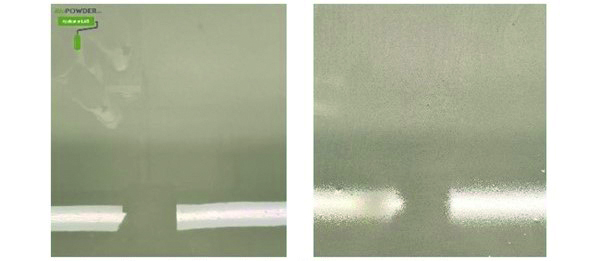
The viscosity became too high, as too much binder was absorbed by the powder particles. While this conventional approach can be valid in some applications, it neglects that the system is designed for mixing components A and B + filler together. In that case, the results were very promising as viscosity was easy to control, and the system showed ideal self-levelling properties.

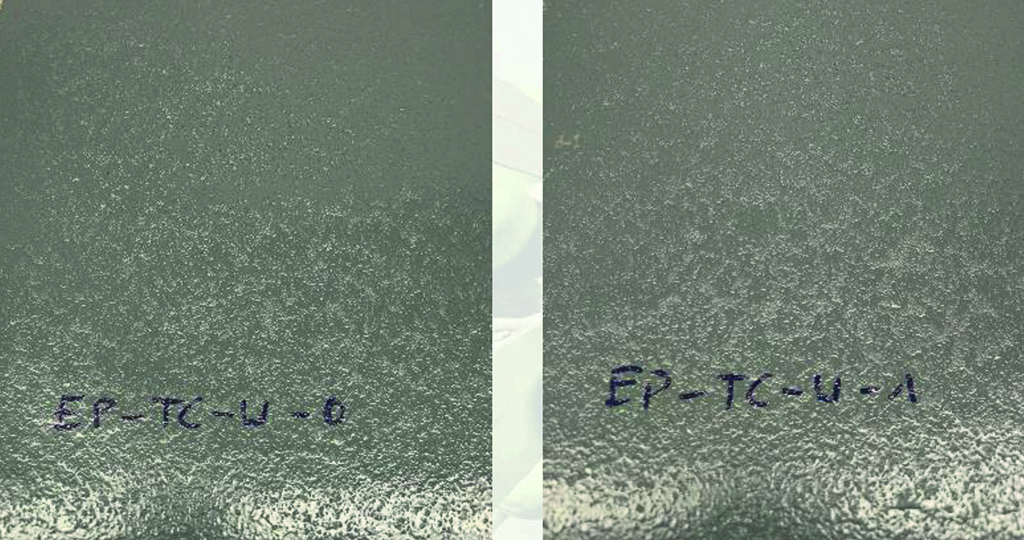
Observations
– Gloss is largely preserved.
– Olea FP particles move to the surface during curing, which creates an anti-slip effect.
Note on volumetric use: CaCO3 or other mineral fillers have a density (specific gravity) of 2.6 – 2.8kg/l. Olea FP, in turn, is a lightweight filler with densities between 1.2 and 1.4kg/l. At first, we tested a 1:1 replacement, although we had anticipated that the weight percentage needed adjustment.
We subsequently replaced 1 kg of CaCO3 with only 0.5 kg Olea FP to reflect the approx. 50 % in weight reduction, i.e. half the weight at an identical volume.
This proportional adjustment produced excellent results and proved the effectiveness of Olea FP as a lightweight filler.
CASE STUDY 2: ALIPHATIC POLYURETHANE (PU) COATINGS
PU systems work with two types of isocyanates: aliphatic and aromatic ones. The former are quite inert in an aqueous environment while, in the latter, water is likely to produce a foaming effect due to a release of CO2.
Conventional PU self-levelling coatings contain around 40 – 50% solids by default. These powders or particles are generally barium sulphate or talcum with particle ranges up to approx. 300 microns.
There are diverse opportunities to replace part of those non-renewable powders with BioPowder Olea FP in similar particle diameter ranges. A volumetric replacement is recommended for viscosity control, light weight of the coating and mechanical performance.
CASE STUDY 3: POLYASPARTIC COATINGS
Polyaspartic resins are a number one choice for scratch- and abrasion-resistant floorings. The formulations are often applied in thick layers in the millimeter range. In filled systems, the filler content can be high, which means that high doses of bio-content (biodegradable matter) can be incorporated. Compatibility tends to be impeccable.

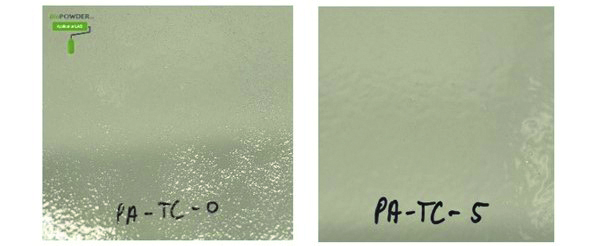
Observations
– Both quartz and Olea FP create an anti-slip effect.
– PA-TC-5 produces an ‘orange peel’ texture during curing.
This surface is particularly suitable for matte floorings and automotive fittings.
ADVANTAGES OF OLEA FP FOR COATINGS IN A NUTSHELL
– Improved hardness and resistance: abrasion test results available.
– Matting effects: reduction of gloss even at low doses below 5%.
– Unique design and anti-skid effects
– Reduced curing times: internal studies have demonstrated an acceleration of curing/hardening by 50 % (after one night) when quartz is replaced with Olea FP by mass.
– Reduced adhesiveness (‘stickiness’) in PU systems: surfaces become easier to clean.
– Enhanced recyclability due to biodegradable content.