From challenge to innovation: how the future of the DTM paints is changing

Cristiano Tunice – IMCD ITALIA
Roberto Paleari, Michele Mazzi – LAMBERTI

Introduction
The DTM market is evolving to meet the growing demand for water-based paints. Lead for a long time by the solvent-based systems, due to their durability and fast drying property, the market is now constantly demanding more eco-friendly solutions, which better suit the more and more stringent environmental regulations. The Lamberti research and development Team is developing new technologies to meet these trends. This path led them to develop a new product: Esacote® AC 509, a water-based acrylic resin for high-performance anticorrosion systems.

DTM market survey
Since the market demand is constantly changing and the request of waterborne DTM systems is still growing, the opportunity to use Lamberti’s skills has been exploited in the coil sector, where this company has been working for a long time offering polyurethane solutions both for pretreatments and antifingerprint, continuously developing innovative solutions for the general industrial and DTM sector. This market is currently valued at approximately $16 billion and is expected to grow up to $27 billion by 2032, with a CAGR (Compound Average Growth Rate) of 6.1%. Since long time, solvent-based systems have dominated the DTM market, due to their durability, fast drying times, and resistance to extreme conditions. From a technological point of view, in 2023 water-based systems accounted for approximately 32% of the market, with significant growth forecast by 2032. This growth is linked to their eco-friendly characteristics and low VOC (Volatile Organic Compound) emissions, which align these types of products with stringent environmental regulations. While solvent-based systems still dominate some specific applications, the transition to water-based solutions is now a matter of fact. So, Lamberti has decided to combine their know-how in the application field with the available synthesis skills. They decided to invest on the development of an acrylic resin  rather than on a PU type, due to its higher corrosion resistance and better adhesion to metal substrates.

The birth of Esacote® AC 509
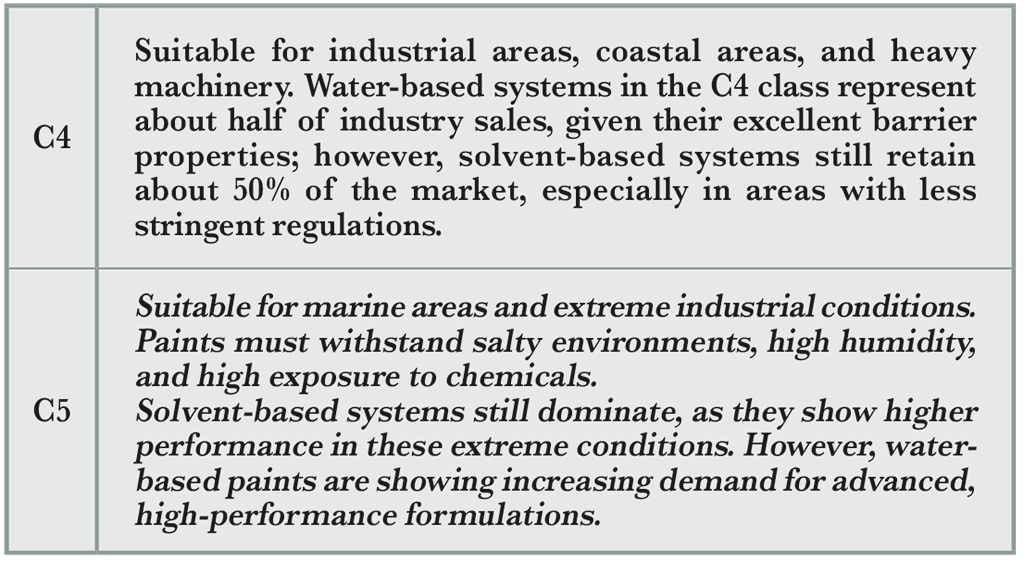
In the world of protective coatings, corrosion resistance is a primary challenge. General industrial and heavy-duty applications require solutions that extend the life of metal parts, cutting the maintenance costs, and complying with the increasingly stringent environmental regulations. Considering the corrosion classes described in ISO 129444-2,

it seemed that the most attractive area for the development of a new resin was the C4-C5 segment (see below), where advanced technologies could bring a more significant impact.

A preliminary development phase was launched, analyzing the resins already available on the market to better understand their strengths and weaknesses. This preliminary work provided in-depth information useful to develop a new resin for DTM. By using the first results, Lamberti identified three essential conditions to develop a resin that could behave as a good anticorrosion paint.
– Excellent adhesion to metal substrates, both dry and wet.
– Corrosion resistance.
– Water resistance.
The lack of any one of these fundamental requirements would have undermined the overall effectiveness of the binder. Therefore, the first objective was to develop a prototype able to meet each of these three needs; otherwise the resin would have been rejected. Along with these minimum requirements, two specific market demands were also identified:

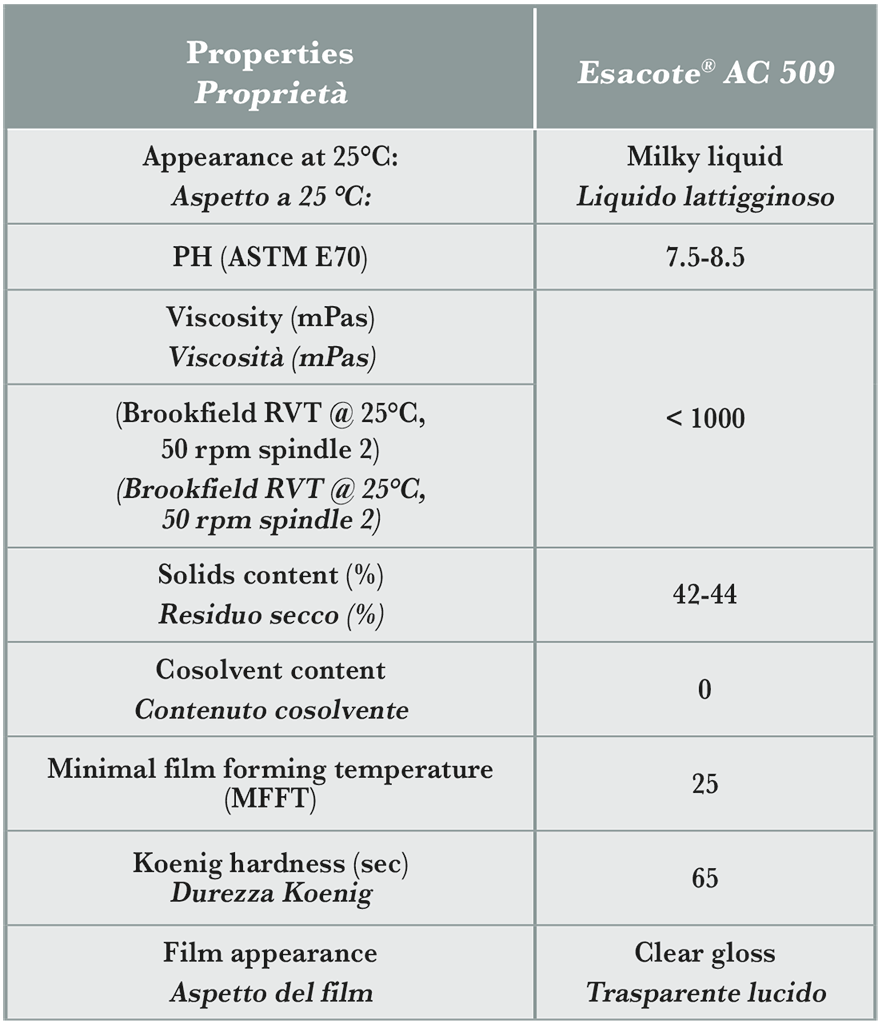
Tab. 2 – Properties of Esacote® AC 509

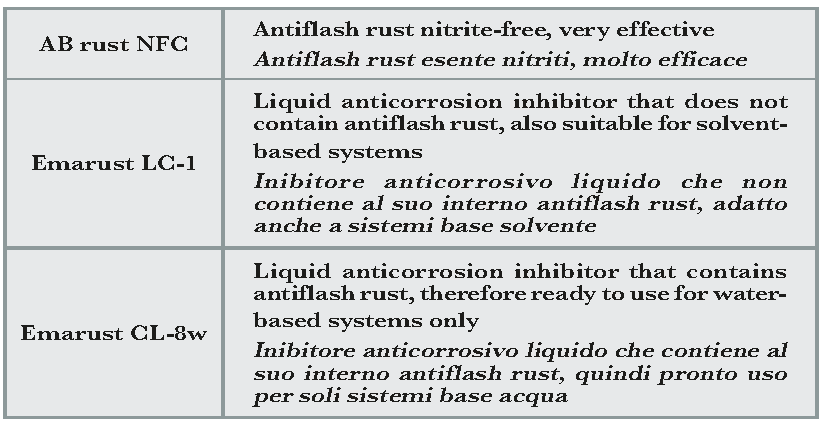
Tab. 3

– low cosolvent requirement (hence low MFFT).
– Good blocking resistance (hence excellent hardness).
Based on this scenario, it was decided to develop an acrylic binder synthetized through a multiphase technology, since it should have been the best technology to guarantee the required performance.
Below we report the operating conditions used during the resin development.
Substrate: CRS QD-36.
– Thickness: 50 microns dry.
– Spray applications.
– 7 days drying in a climatic chamber (23° C/50%HR).
– White pigmented TiO2 based formulations.
During the preliminary screening, the following tests were implemented:
– dry and wet adhesion (40° C water immersion).
– Water resistance.
– Salt spray test.
– ACET ISO 17463 measurements.

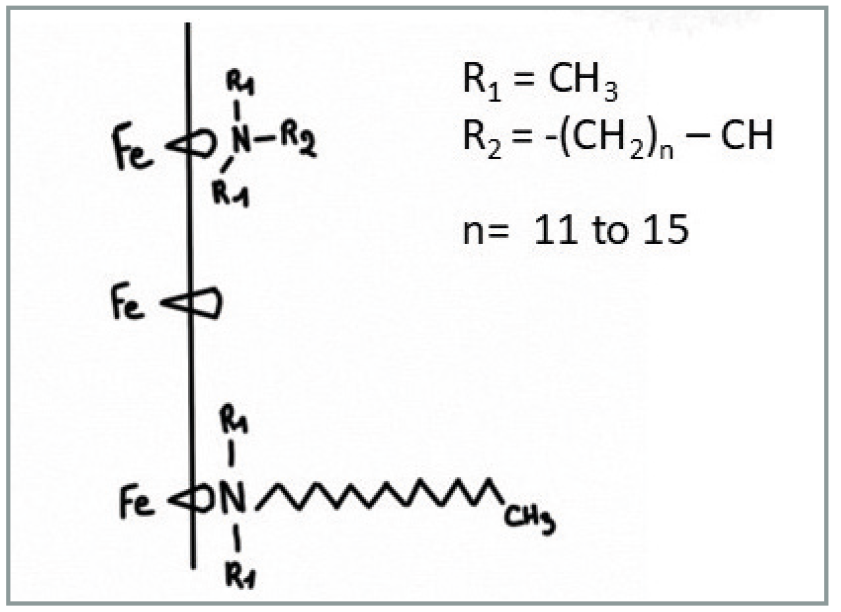
Fig. 1

The Accelerated Cyclic Electrochemical Technique (ACET) provides corrosion protection results in just 24 hours, accelerating the typical corrosion test. Using this device, it was possible to speed up the corrosion resistance results, saving hundreds of hours which should have been requested by the Hot Salt Spray test. Taking all the available results into account, a prototype called ESACOTE® AC 509 was created, providing excellent adhesion results, both on dry and wet substrates, as well as excellent salt spray resistance outcomes.

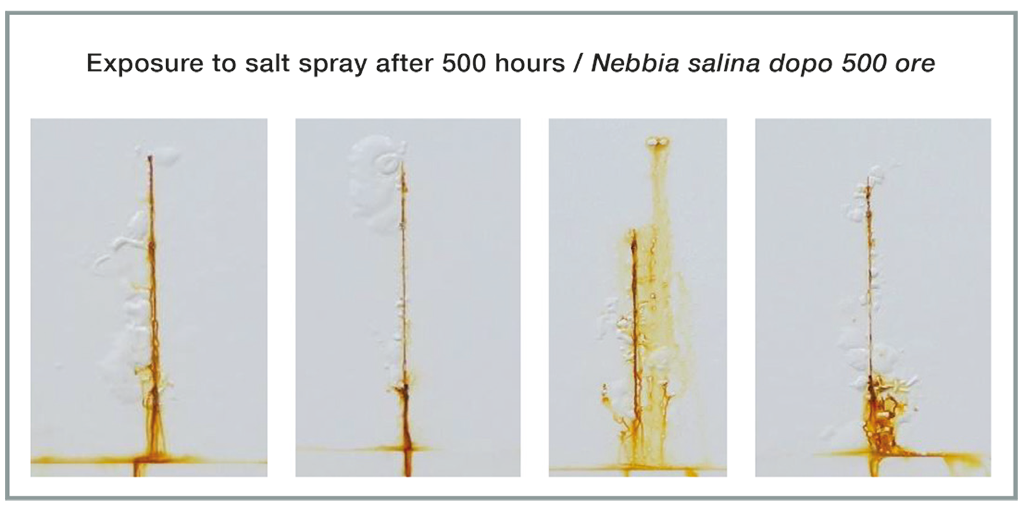
Fig. 2 – Application: 200 microns wet (approx. 85 microns dry) on steel panels (Q-panel S 36). It is clear that the combination of Emarust NFC/LC1 is the one which gives the best result

The resin also performed well in the humidostatic chamber, showing no blistering and providing excellent resistance to QUV. The binder properties, the stadard formulation used in the study, and the salt spray results are reported in Table 2.

Corrosion resistance
In collaboration with Labema, anti-corrosion tests were carried out using some anti-corrosion pigments and anti-flash rust additives, which are listed in the Table 3.
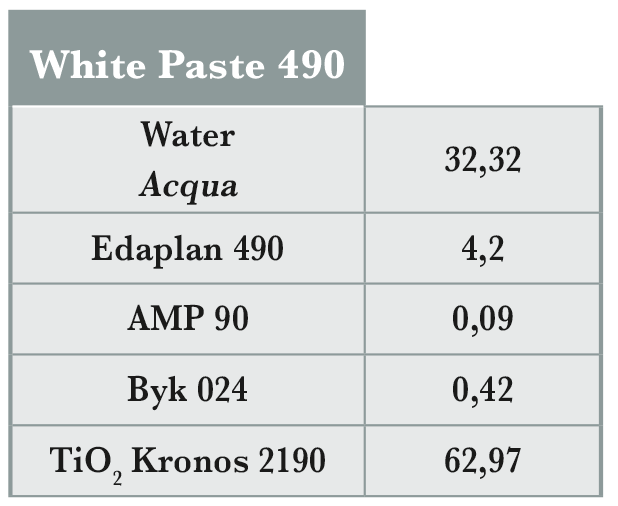
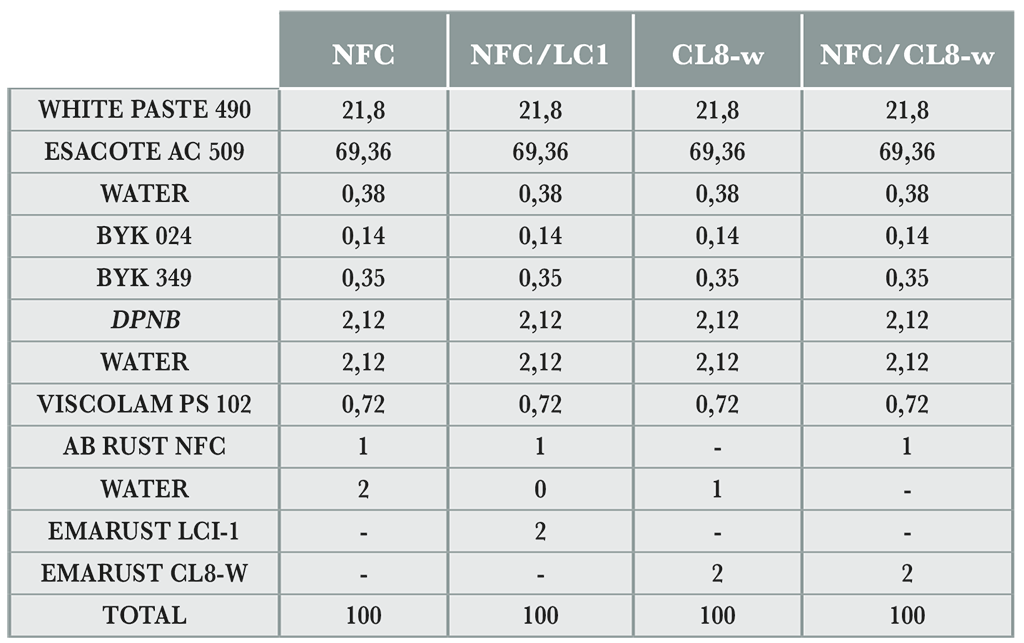
The working principle of the additives is briefly explained in the diagram in Figure 1. As you can see, the adhesion to the substrate is promoted by the nitrogen groups in the chain, and the water repellency is due to the attached alkyl chains. In Table 4 ans 5 are reported the tested formulations (white pigmented primer) and the photos of the panels after exposure to salt spray. It is clear that the combination between Emarust NFC/LC1 provides the best result.

Tab. 4
Tab. 5 – Tested formulations

Conclusions
The development of Esacote® AC 509 is a strategic expansion on the DTM market for Lamberti, combining high performances with sustainability requirements. The resin shows an optimal adhesion and an excellent corrosion and water resistance, thus meeting the fundamental needs of the market.