Craig Frankum, Ad Overbeek, Fred – COVESTRO
With consumers and painters increasingly conscious of the safety profiles of decorative coatings, manufacturers around the world are working to further deliver these solutions. Covestro supports them with this task through its cutting-edge R&D, innovation support, and broad toolbox of advanced resin technologies. Just one example is its polymeric aziridine crosslinker that offers lowered toxicity levels while still delivering equal performance to traditional aziridine crosslinkers.

With recent studies suggesting that 25% of all indoor air pollution now comes from paint, efforts to improve the safety profile and health impact of our decorative paints and coatings are more important now than ever.
In recognition of this issue, and as a player early in the coatings value chain, Covestro continually works to create safer paint ingredients that can keep manufacturers, applicators, and consumers safe. As part of these efforts, for instance, we have worked to lower levels of volatile organic compounds (VOCs) and biocides in our resins, eliminate triethylamine and reduce the use of other tertiary amines that can contribute to strong odors, phase out N-Methylpyrrolidone (NMP), and improve the film-formation of our systems to reduce the need for co-solvents.
We also have a dedicated innovation platform related to detox and compliance, enabling us to further phase out chemicals of concern. In this way, we ensure that our customers can develop safer coatings that futureproof their portfolios against impending legislation changes.
THE FUNCTIONAL PERFORMANCE CHALLENGE
Safer coating technologies can sometimes come at the expense of functional performance – as exemplified by crosslinkers.
They are key to the functional performance of many coa-tings: in self-crosslinkable resins, they improve a wide range of properties, including early blocking resistance, stain resistance, mechanical properties, durability, and toughness. In addition, self-crosslinking systems can also help manufacturers reduce their use of solvents to deliver improved adhesion. To increase properties like chemical resistance and mechanical performance even further, external crosslinkers with a high level of reactivity are preferred. However, the same high reactivity that enables these properties often also comes with higher toxicity.
Traditional aziridine crosslinkers are a good example: their effective crosslinking goes hand-in-hand with a poorer toxicity profile. These crosslinkers are considered genotoxic and mutagenic, and have consequently been phased out in many application areas. Carbodiimide crosslinkers offer a better toxicological profile than traditional crosslinkers, but they typically perform less well at room temperature. To truly enable safer, highperformance coatings, manufacturers need less toxic crosslinkers that don’t compromise functional performance.
AN INNOVATIVE CROSSLINKING SOLUTION
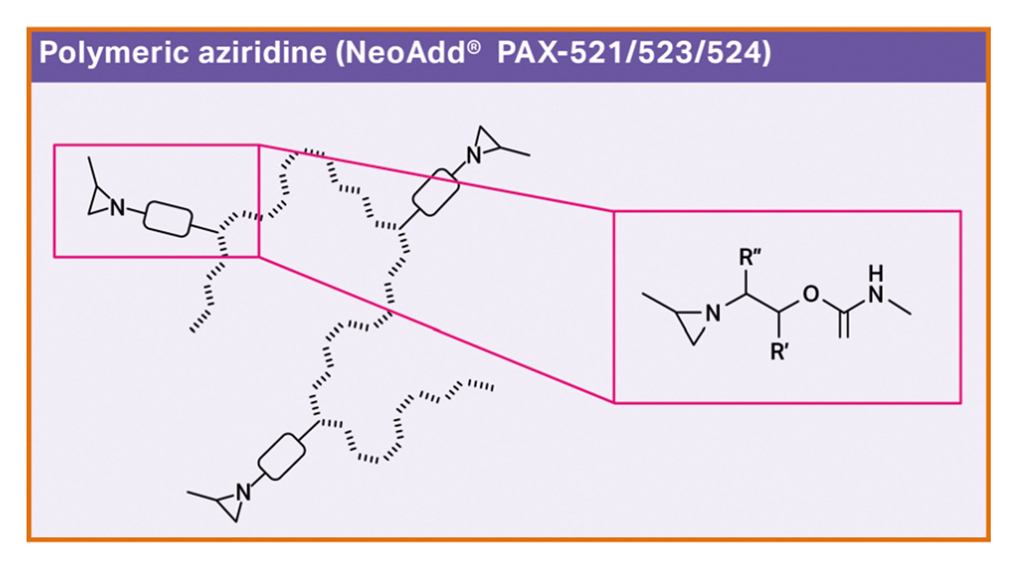
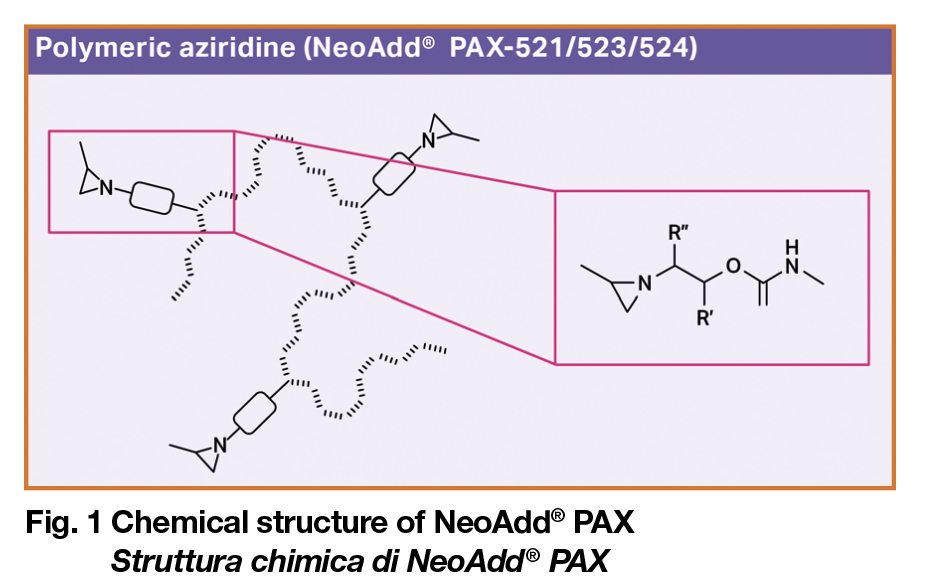
To address these challenges, Covestro developed NeoAdd® PAX: a new family of polymeric aziridine waterborne crosslinkers. Thanks to its unique chemical structure – in particular, its higher molecular weight – the crosslinker delivers the same performance benefits of traditional aziridine crosslinkers at much lower toxicity levels. Specifically, NeoAdd® PAX has passed the AMES test (OECD 471) for mutagenicity, and the extra-reliable Toxtracker® and OECD 487 tests for genotoxicity.
As well as protecting applicators and consumers from potential safety risks, these properties also mean that this crosslinker has lower labeling requirements; it requires only two safety labels, one of which applies to the solvent it is dissolved in, rather than the polymeric aziridine itself. This puts it on a similar labeling level to most carbodiimides. The product is also REACH compliant, pending TSCA certification, and approved for sale in countries such as China and Canada.
Unlike carbodiimide crosslinkers, as a polymeric aziridine, the product offers the high reactive performance benefits of traditional aziridine chemistry – and key performance advantages compared to most carbodiimide-based crosslinking systems. Most importantly, this crosslinker offers higher reactivity and higher chemical resistance at lower dosing levels compared to carbodiimides, and is effective for almost all polymers even at room temperature.

Indeed, Covestro has compared the reaction kinetics of NeoAdd® PAX-523 – specially designed for use in waterborne architectural coating systems – with CX-100, a benchmark aziridine crosslinker, at room temperature. The test used elastic modulus as a measure of crosslinking density. As the graph below shows, the product demonstrated faster reaction kinetics than CX-100. What’s more, the ability to be cured at room temperature also eliminates the need for stoving ovens, enabling formulators to improve processing efficiency and save money, time, and energy. And the resulting reduced carbon emissions also improve the crosslinker’s sustainability profile.
EXCELLENT SECONDARY FUNCTIONAL PROPERTIES
As well as its effective crosslinking, the product also delivers excellent secondary properties that enable flexible and reliable application. For instance, because of its high levels of stability in water, it offers a pot life of up to seven days depending on pH – compared with a typical 12 hours for traditional aziridines. Next to this, this crosslinker also offers excellent resistance to water, chemicals, scratches, scuffing, and abrasion, delivers outstanding adhesion to a wide range of substances, and can even function as an adhesion promotor.
The company has tested the performance of the product against other crosslinkers for several of these properties. Firstly, we tested the mechanical resistance properties of NeoAdd® PAX523 compared with CX-100 and carbodiimide crosslinker CX-300, using the realistic required proportions of each crosslinker for a floor coating formula based on NeoCryl® XK-12.
As the (Tab. 2) shows, NeoAdd® PAX-523’s total score for black heel mark resistance (BHMR) far outperformed CX-300’s and was close to CX-100’s. All three crosslinkers scored the same for nail scratch resistance, improving this property by 1 point compared with no crosslinker.
Secondly, the R&D company’s team measured the chemical resistance of NeoAdd® PAX-523 in a wood flooring coating based on NeoRez® R-2005, again using the realistic required proportions of each crosslinker. Chemical resistance against several substances was scored from 1 to 5. As shown in the table below, using NeoAdd® PAX strongly improved the coating’s resistance to water, ethanol, and ammonia compared with no crosslinker.
ALL THE PERFORMANCE, HALF THE LABELING
NeoAdd® PAX is just one example of how innovative resin R&D can unlock new horizons for safer, more effective decorative coatings. Indeed, Covestro offer multiple resin innovations to help its customers meet the latest decorative coating market needs. Through technical support and targeted innovation workshops, as well as its broad toolbox of advanced resin technologies, the company can support you to develop safer, more sustainable, high-performance decorative solutions – for a brighter coatings future.
In Italy these products are distributed by Tillmanns