Elisabeth Meints – HOBUM Oleochemicals
Biobased raw materials have been used for ages and were important pioneers in the success of petrochemicals. Even as petrochemical feedstocks became more diverse, biobased feedstocks could not be completely replaced due to their performance. In recent years, there has been renewed interest in biobased feedstocks. The climate crisis and the finite resource of crude oil are accelerating this necessary paradigm shift. With regard to climate change mitigation, it is necessary to ensure that biobased alternatives reduce the carbon footprint.
Soy production has grown steadily in recent decades. Driven primarily by rising meat consumption and the resulting higher demand for protein-rich feed, in the form of soybean meal. To meet this demand, precious rainforest has been cleared. The conversion of forest areas releases immense amounts of greenhouse gases. As a result of the decreasing areas less CO2 can be stored. In particular, the consumption of beef, palm oil, cocoa and coffee in the European Union and other industrialized countries is driving deforestation and forest degradation worldwide. The European Union wants to put a stop to this by banning raw materials and products that contribute to deforestation from the market.
In 2023, the EU Deforestation Regulation EU 2023/1115 was published and will come into force from December 30, 2024. It obliges market participants to design the entire supply chain deforestation-free and ensure this through documentation. HOBUM already offers deforestation-free polyols, epoxidized oils and their esters. For this purpose, we process soybean oil certified by the Round Table on Responsible Soy (RTRS) Association into Merginol and Merginat products. This certification ensures that soy plants are grown on land that has not be cleared after December 2020 and that responsible working conditions and agricultural practices are observed along the value chain. In addition, we offer a ‘new environmental option’ grade for all soybean oil-based products. For the neo quality, HOBUM focuses on more regional sourcing and processing. Merginat neo and Merginol neo products are manufactured in a batch process using soybean oil produced in Germany. The seed used comes from European cultivation. Together with shorter transport distances, emissions are reduced to such an extent that European soybean oil produces only one-third of the emissions in terms of CO2 equivalents compared with non-certified, international soybean oil.
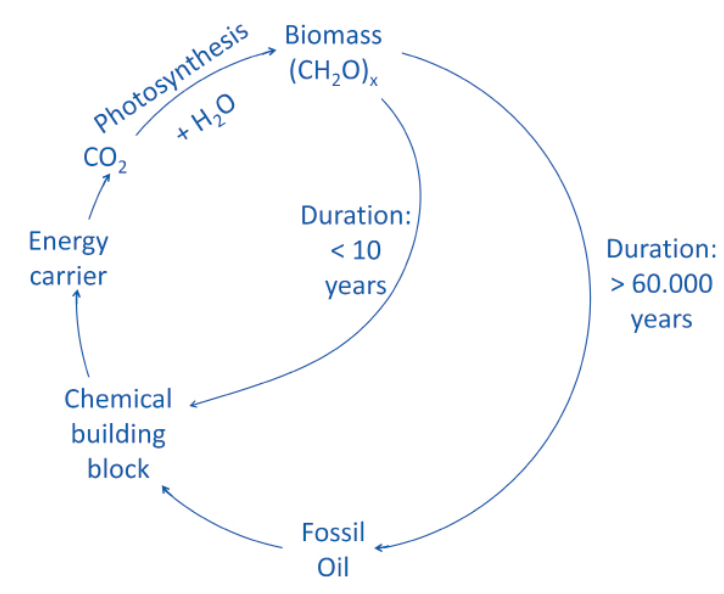
Soybean oil is an important CO2 storage per se. The soy plant converts CO2 to biomass as it grows (Fig. 1). For fossil oil, this process occurred over 60,000 years ago. At the end of life of petrochemical-based products, this CO2 is released again. Since more CO2 has been released into the earth’s atmosphere in recent decades than has been sequestered, the earth is warming up. The use of biobased raw materials as chemical building blocks is now helping to sequester CO2 from the atmosphere. This makes the material use of biobased rather than petrochemical feedstocks a key element of decarbonization.
The soybean has a high meal content of about 80%. Soybean meal contains a lot of high-quality protein and thus is an important source of protein for livestock. About 20% oil can be obtained from the soybean by extraction. In the European Union, 53% of soybean oil is used for food, 43% for biodiesel and only 4% for industrial applications. There are concerns that if soybean oil is used for industrial applications, the resources will not be sufficient for food production. Figures show clearly that livestock feed is a main driver for soybean production and biodiesel is the main competitor to the food use of soybean oil. In the overall picture, material use of biobased materials is preferable to energy use because CO2 is stored for longer over a life cycle with material use. The use of biobased feedstocks based on food and feed crops is discussed in detail in the Renewable Carbon Initiative study “Use of food and feed crops for biobased materials and the related effects on food security”.
HOBUM has been producing novel, biobased materials from vegetable oils for applications in various fields for more than 60 years as a family-run company in Hamburg. Formulations with these biobased products meet the highest requirements, some of which cannot be met with petrochemical building blocks. The combination of defined introduced reactivity and the natural hydrophobicity results in a large and flexible toolbox to meet or exceed the desired properties. The modification possibilities are far from exhausted.
How many tonnes of bio-based chemicals HOBUM can manufacture and supply every year?
Approx. 15.000 mt.
What is the main challenge nowadays to propose biobased chemicals to the paints and coatings manufacturers?
Sustainability has become a ‘megatrend’ and that is long overdue. Companies, institutions, and individuals now care about origin, processing, usage, and end of life of products. This increased awareness creates pressure. In some cases, it leads to products with a green veneer where there is little or nothing biobased in the product. Calculating the Product Carbon Footprint (PCF) and afterwards a Life Cycle Analysis (LCA) is challenging, especially due to the availability of data and the complexity of methodologies. But at the same time, it creates the transparency and accountability needed to proof the sustainability of products.

We see the use of biobased chemicals, resins and additives is still low in the paints and coatings industry. What is your opinion of the market?
The demand for biobased chemicals will increase in the European paints and coatings market. The Green Deal forces the industry to speed up the transformation towards more sustainable products. Currently, the prominence of biobased products is not that high yet. Petrochemicals have dominated the raw material market in the last decades. Our biobased products are in the market for more than 60 years and were used because of their high performance. Lately the interest in the edible-oil origin and the high biobased carbon content has become more relevant. To fulfill the market needs, we will intensively work with our new distribution partner for the Italian market, IMPAG.