Frank J. Maile – SCHLENK
Jiri Filip – SightTex
Realisation of gold-alloy shades using effect pigments
Various effect pigments like pearlescents and metal pigments made of gold or copper-zinc alloys have long been used to decorate surfaces in a wide variety of applications, although there is a difference in color formation. Colors in metallic elements and their alloys can be explained using band theory whereas the formation of (interference) colors in pearlescent pigments occurs through thin layers of higher refractive index deposited on semi-transparent substrates with platelet-like morphology[3]. Furthermore, compared to the physics of the gold-silver-copper alloys and their object surfaces, particle properties such as scattering at pigment edges and particle orientation must be taken into account when processing effect pigments in coatings, printing and plastics applications to achieve gold color shades on objects, since these significantly influence the final appearance [4].
All pigments used in the innovative ternary system (ZTS) presented in this paper are based on ultra-thin pigment technology. At the heart of this UTP (Ultra-Thin Pigment) technology is the pigment design. The core of the pigments is an ultra-thin, monolithic aluminum substrate with a typical particle size of 21 μm (D50) and a thickness less than 30 nm, resulting in an unprecedented aspect ratio (the ratio of the largest dimension to the smallest), which is a prerequisite for a good flop. This aluminum substrate is then coated first with a low refractive index metal oxide and then with iron oxide to obtain the desired interference color. While silica and iron oxide layers can be deposited in precise thicknesses during pigment synthesis, conventional aluminum substrates cannot be produced in a very narrow thickness distribution.
With the new UTP technology, on the other hand, the thickness of the aluminum substrates is negligible in relation to the overall thickness of the pigment, so that variations in the thickness of the substrate do not play a role – the pigments therefore all have the same thickness[1].

Introducing the ZTS ternary system
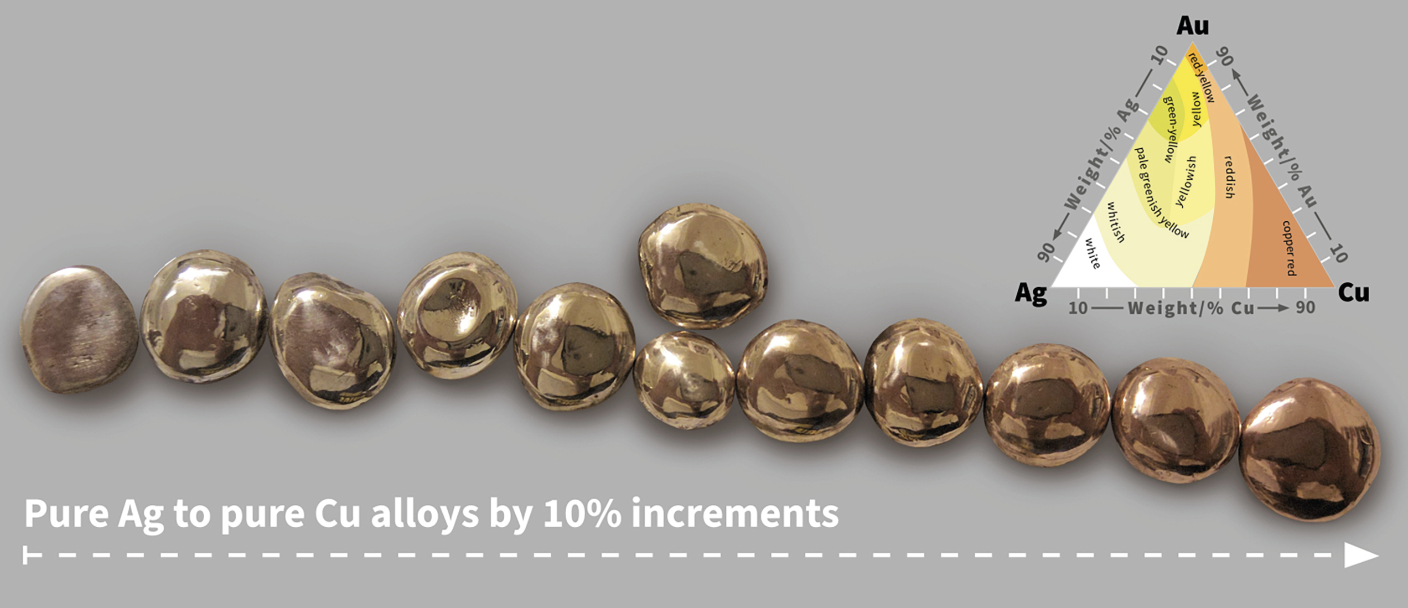
The idea for the ZTS was to exploit the extraordinary optical properties of the effect pigments based on UTP and to generate a mixing system, but the inspiration came from the well known Au-Ag-Cu ternary system[2] which is the basis of the most commonly used gold jewelry and dental alloys today. By varying the composition of the Au-Ag-Cu system, a variety of hues and colors can be obtained, as shown in the ternary phase diagram in Figure 1. In this figure it can be seen, that the addition of copper gives the alloy a reddish hue, while the addition of silver makes the alloy greenish. This is consistent with band theory as the addition of silver causes an increase in the energy gap that the electrons must overcome to reach an energy state above the Fermi level[5].

Using the Au-Ag-Cu ternary plot, three pigments were synthesized using the ultra-thin pigment (UTP) technology. The optical properties of the three corner pigments based on UTP-technology used in the ZTS (YY-YS-OO) have already been discussed in detail elsewhere [1], here´s a quick review of the most important pigment benefits. The thickness of the aluminum substrate was reduced to a minimum and the weight percentage of aluminum in the pigment is in each case pigment is less than 15%. For this reason, too, the pigment can be handled as a dry powder and, as confirmed by the German Federal Institute for Materials Testing, is neither flammable nor does it lead to dust explosions. Metal interference pigments can therefore be marketed as a powder without the need for solvents or hazardous goods labels. So, apart from the safety benefits, users also benefit from being able to use a 100% powder product, which in turn allows more accurate dosing and easier formulation of waterborne coatings and sensitive coatings with high solid content.
Therefore the properties of effect pigments based on UTP technology, both in terms of their colorimetric and physical properties, represent perfect starting conditions for a mixing concept. This is also because the pigments can be processed in various applications like powder coatings, water- and solventborne coatings, printing inks and in plastics applications, where they can develop their coloristic properties.

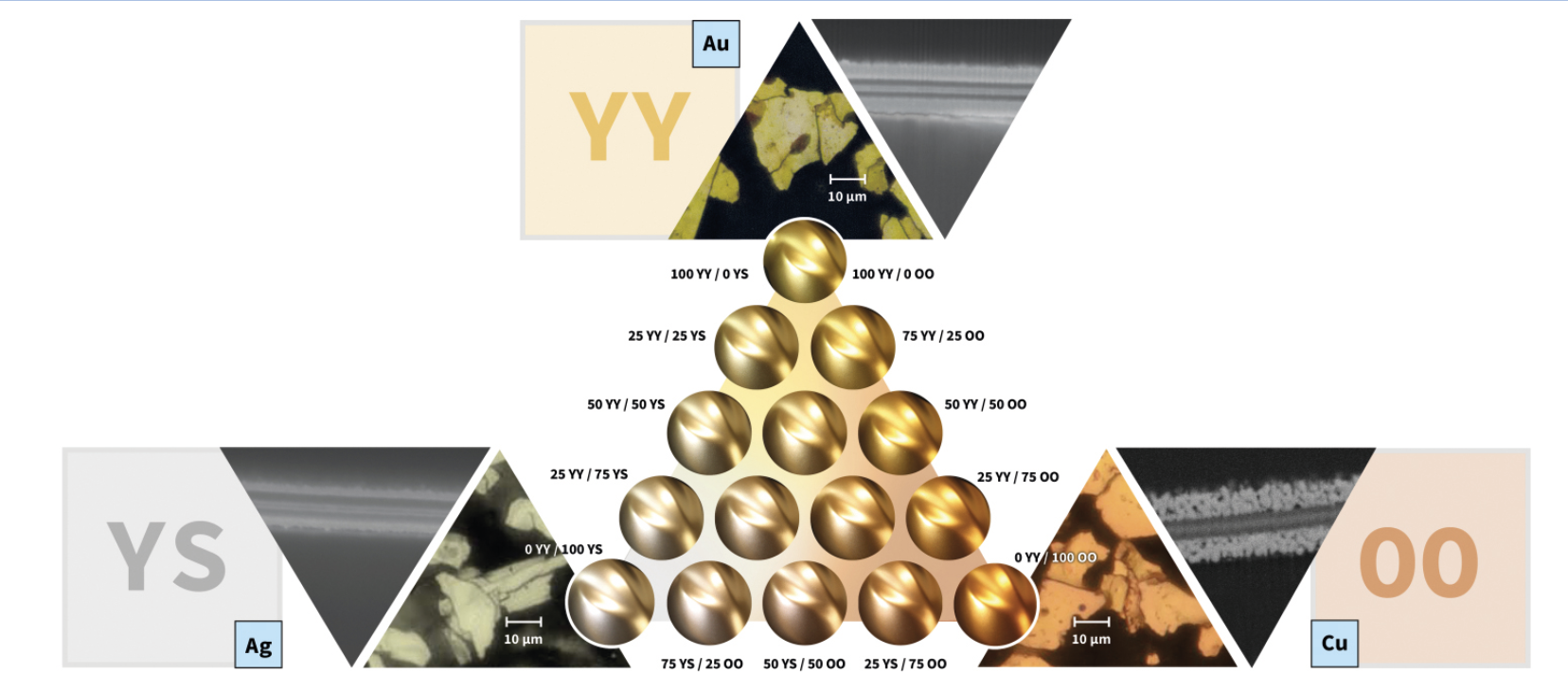
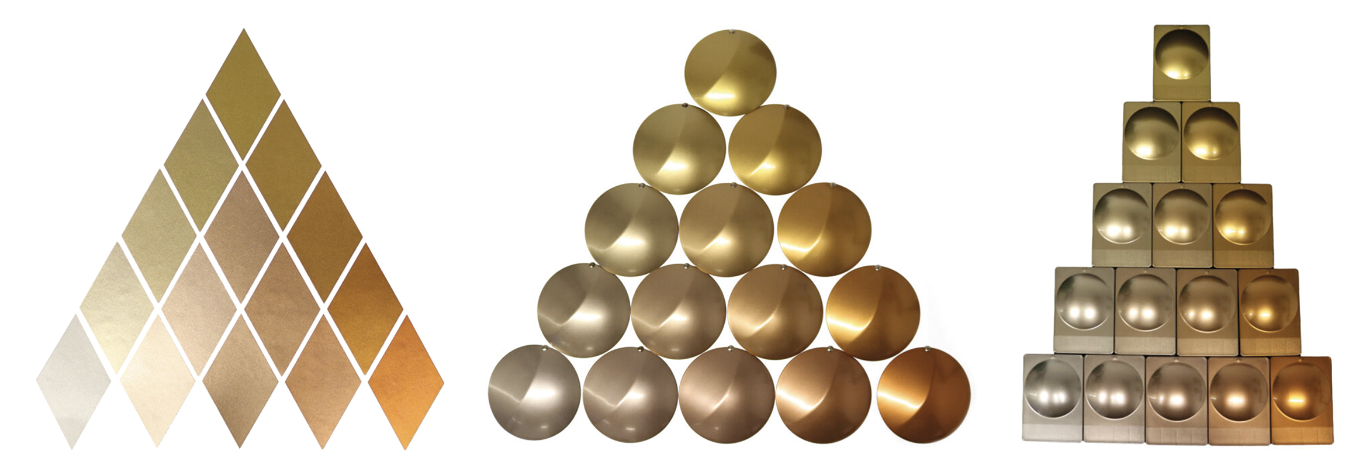
Mixing of the three UTP types YY-YS-OO is trouble-free due to similar physical properties of the particles, and in the final application brings, among others, the advantage of no segregation (e.g. in dry-blend applications resulting in highly chromatic powder coatings) and intrinsic laser marking properties resulting in not haptically perceptible markings and can be transferred to all applications as shown in Figures 2 and 3.
Since, as mentioned above, dispensing is easy, the desired golden shades in the ZTS can be pigmented or worked out accurately.
Figure. 2 presents the new ternary system (YY-YS-OO) based on UTP pigments, where the (semi-) precious metals gold, silver, copper (Au-Ag-Cu) were replaced at the corners by the respective effect pigments. Here, the ZTS system is based on an aqueous automotive basecoat and has been sprayed pneumatically using a HVLP gun ad a spraying robot onto small ABS speed shapes for better visualization of color and flop. In order to define the samples used and their designation in the further course of this publication, we will refer to ZTS Coatings (ZTS CO) in the future.
As mentioned, the UTP pigments can be used in many other applications, which is why it was decided to present them here not only in waterborne, but also powder coatings, (screen) printing and plastics application, the result of which can be seen in Figure 4. Without listing the exact technical application parameters here, these samples are called ZTS PC (powder coating), ZTS PR (screen printing), ZTS P (plastic injection molding) and can thus be clearly assigned in the further course.

Based on these pictures, it can be understood that the ZTS approach works excellently in the individual applications. It should be noted, however, that the color shades in the positions in the respective ZTS for one application must not be compared with the other on a colorimetric level. Even if the percentage composition is identical from application to application in one position in the ZTS, other factors contribute to the fact that the realized shade differs in color and on a colorimetric level. The respective ZTS should therefore be considered as a starting point and formulation aid for the elaboration of golden shades similar to Leuser’s (Au-Ag-Cu) ternary system, in which the desired target shade can be decided and then – within an application – this shade can be realized by mixing the respective, pure starting components (YY-YS-OO). The final pigmentation level is then also taken into account, depending on the respective application and the customer’s system. Further fine-tuning to achieve the desired gold shade can then be done by the customer himself and leads to know-how protection on the formulation side, since the final composition is known only to him.

Coloristic evaluation
However, regardless of the known differences in the applications studied, it was necessary to characterize and compare the individual ZTS samples (PC, CO, P, PR) from Figures 2 and 3, which will now be done below. As an example, one color shade containing all three UTP pigments was selected from the ZTS, it contained 50% OO, 25% each of YY and YS. This color shade was now produced in different applications as shown in Fig. 2 and 3. In order to better understand and characterize the ZTS of the individual applications, a completely new device was used, which allows both the characterization of the appearance and the visual display of the measured data.
Introduction of a new measuring device
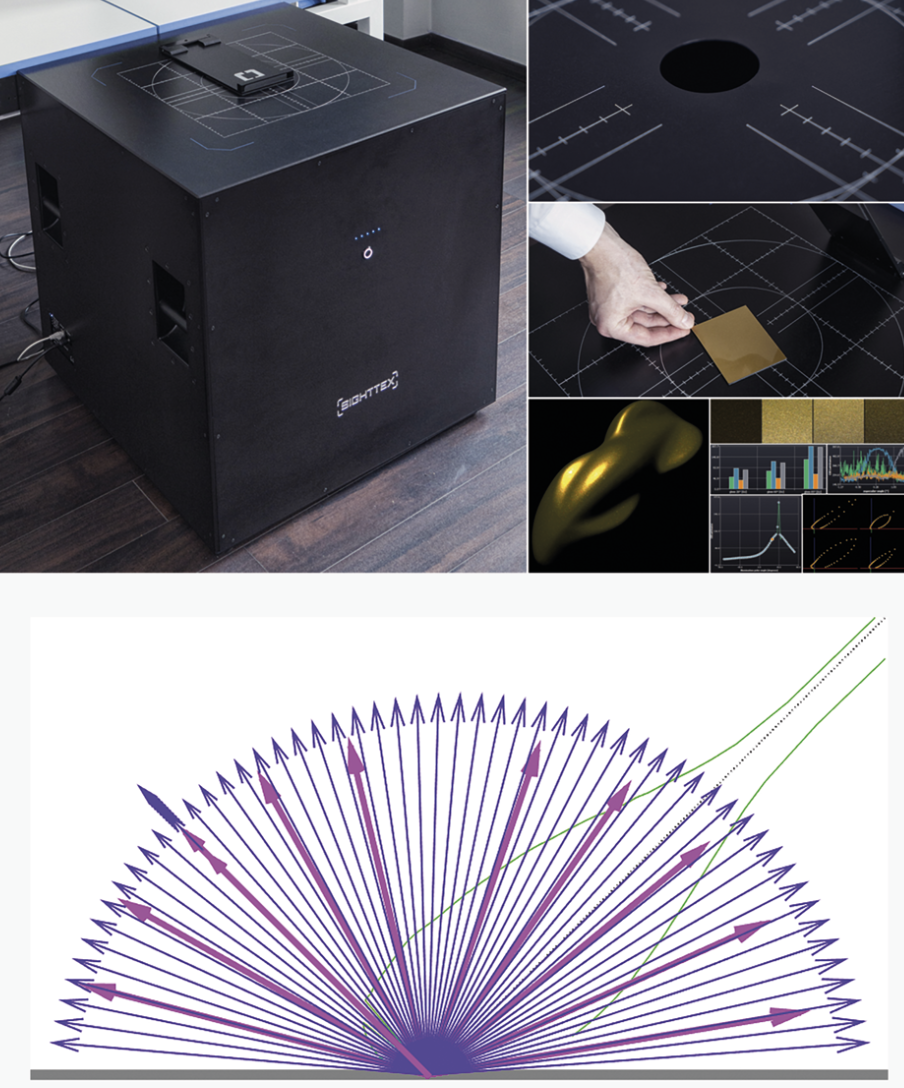
The SIGHTTEX Q[7] is a new device for sensing the appearance of materials, resulting from decades of academic research[8] and years of technical development. It consists of 5 high-resolution industrial RGB cameras mounted in-plane at angles of 15°, 30°, 45°, 60°, and 75° and 28 LED point lights mounted in-plane at 3° increments between 0° and 81°. Cameras and lights allow independent adjustment of any azimuthal (out-of-plane) angle from 0-360° with 0.1° repeatability. The instrument can capture the appearance of the material with a resolution of up to 1500 DPI, which corresponds to a pixel-size of 17 m (59 pixels/mm). This configuration provides a wide variation of geometries that can be captured, giving the device versatile capabilities.
The device is used as a standard flatbed scanner with the material sample positioned over a 40 mm aperture at the top of the device, as shown in Figure 4. Because of this design, also nearly flat parts of non-flat objects can be analyzed.
The device can capture visualization data in several material-specific modes, which allows interactive viewing and illumination on a user-defined geometry. It also captures detailed statistical and texture data for quality control and other applications. Accompanying software offers color, reflectance and texture analysis. Coating-specific tools allow analysis of gloss, sparkle, and graininess, comparison of textures and statistics for inplane geometries. Particle distribution tool estimates particles inclination and anisotropy distributions. The photometric tool provides an estimate of the normal, albedo, and elevation maps of the material per pixel. The versatility of the instrument allows data for the above analyses to be collected in a single scan that takes between 2 and 40 minutes, minimizing the need for sample manipulation on different analysis platforms.

A comparison of the ZTS applied to different applications
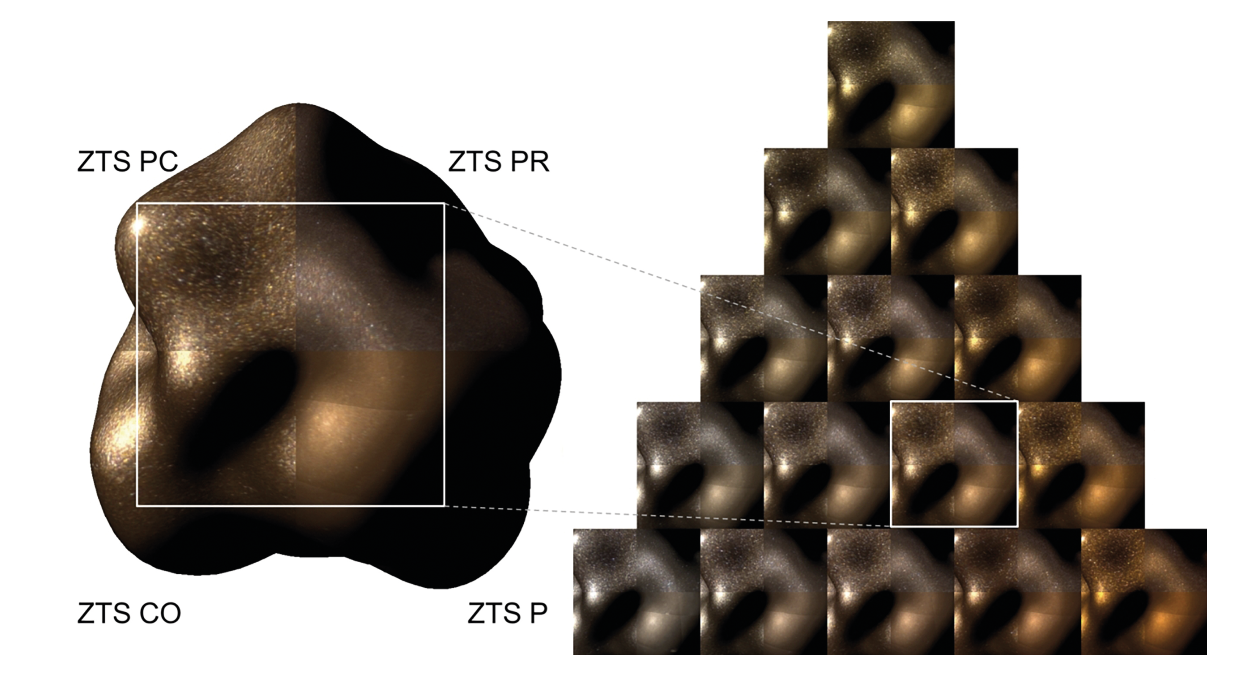
First, all samples of 15 ZTS color shades were captured for four different applications (PC, PR, CO, P), then collected and visualized on a blob shape as shown in Figure 5. As the data collected include the behavior of the coatings under different illumination and viewing geometries, it is possible to display a ‘virtual layer’ on literally any 3D object shape.
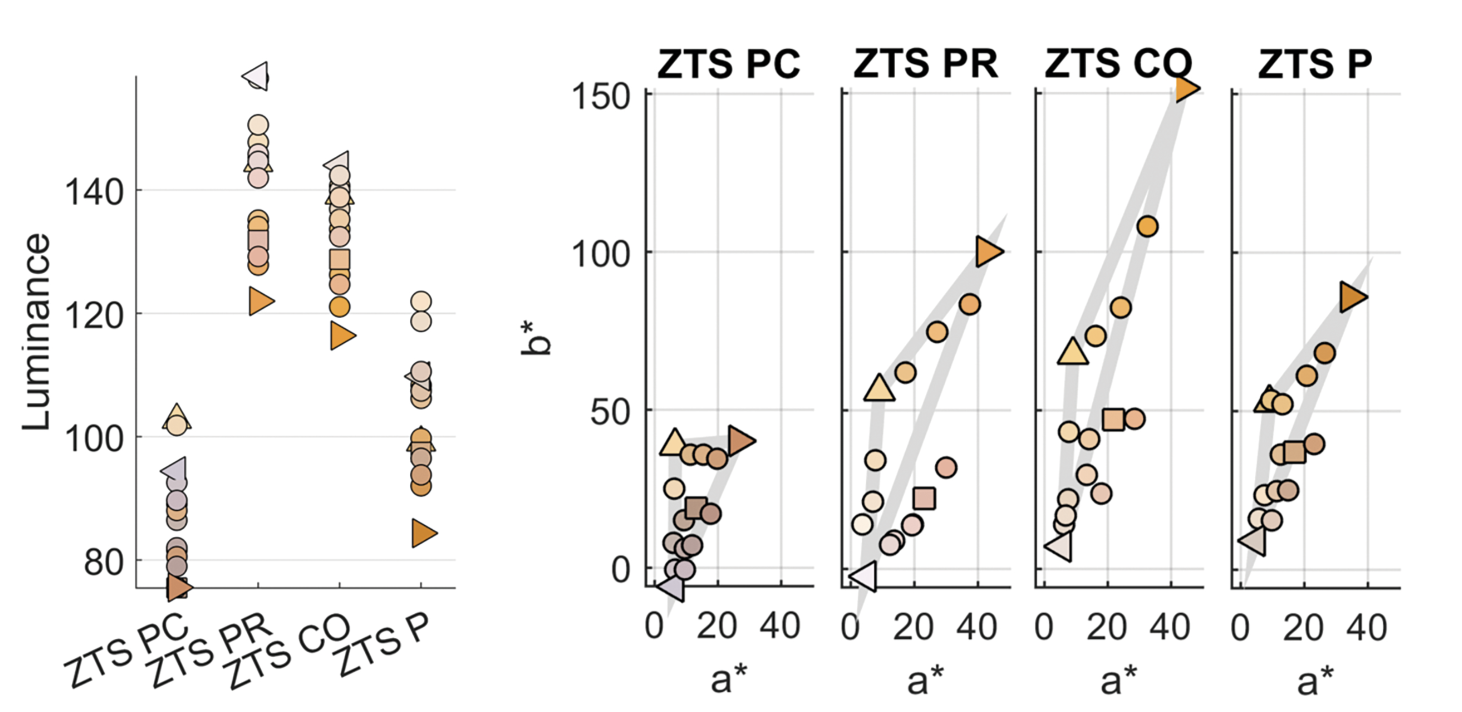
Color analysis of the acquired samples in the CIE Lab color space revealed, as expected, significant differences in luminance and chromatic behavior between the tested application methods, as shown in Figure 6 for the 45°/30° (45°/15°) near-specular geometry. When comparing the luminance values, we observe higher values for ZTS Printing and ZTS Coatings. The same behavior can be observed with respect to the color scale, with ZTS Printing and ZTS Coatings showing significantly higher values, especially in the b* channel.
While the analysis of color, gloss, sparkle, and graininess has become the industry standard, the instrument also allows the characterization of particle orientation which is not presented here.
In conclusion, it can be said that the combination of both innovations creates customer benefits because, on the one hand, the new ternary system (ZTS) based on the three basic pigments (YY-YS-OO) enables the rapid formulation of gold color shades in a wide range of applications, and, on the other hand, the new measuring instrument enables rapid and comprehensive characterization of the surfaces produced, so that experience has shown that laboratory processes are simplified, thus enabling cost savings.
“The original paper has been published in ECJ 12/2022”.
Acknowledgement
The authors would like to thank Dr. Adalbert Huber (Schlenk Metallic Pigments GmbH) and Dr. Radomir Vavra
(SightTex s.r.o.).
References
[1] Huber, A, Maile, F.J. European Coatings Journal, 03 2021
[2] J. Leuser, Metall., 1949, 3, 105
[3] K. Nassau, Colour Res. and Appl., 1987, 12, 4
[4] Maile, F.J., Reynders, P., Pfaff, G., Progr. Org. Coat. 54 (2005) 150–163
[5] S. Watanabe, in ‘Precious Metals Science and Technology’, eds. L.S. Benner, T. Suzuki, K.Meguro and S. Tanaka, International Precious Metals Institute, Allentown, 1991, 1,
[6] https://www.reddit.com/r/metalcasting
[7] https://www.sighttex.com/
[8] Filip, Jiří, Radomír Vávra, and Mikuláš Krupička. 2014. “Rapid Material Appearance
Acquisition Using Consumer Hardware” Sensors 14, no. 10: 19785-19805. https://doi.org/10.3390/s141019785