Chip Palmer – ETHOX CHEMICALS / Artur Palasz – SPEKTROCHEM COATINGS LABORATORY
Introduction
Temperatures drop during winter, especially in the northern US or in the northern Europena countries. At this time, waterborne paints based on polymer latex binders are also transported to paint stores and construction sites. Sometimes, heating failures in vehicles or in warehouses cause frost to affect paint buckets. During unloading of paints, accidental freezing may also occur, which is difficult to avoid.
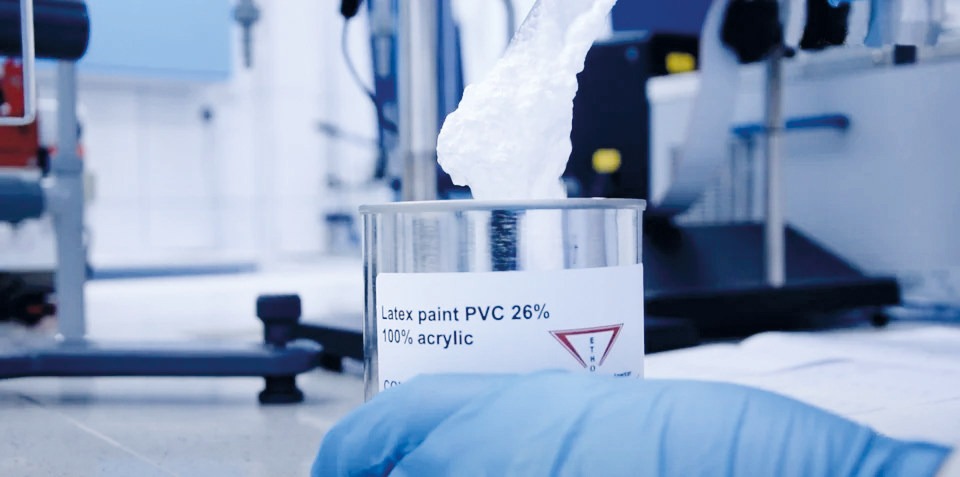
Fig. 1
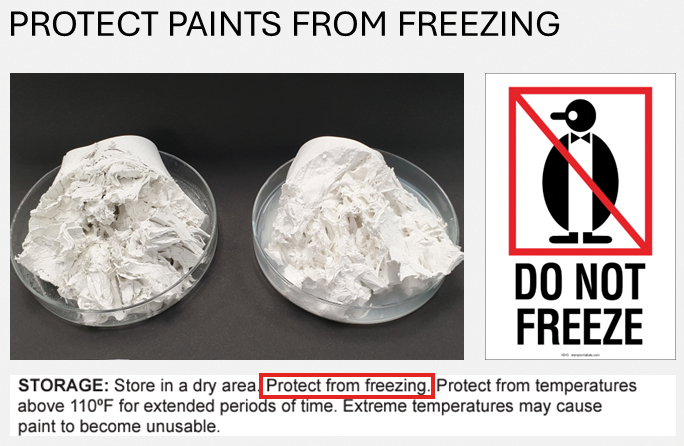
Waterborne paints based on polymer dispersions (latex binders) are sensitive to frost. Each label bears the “protect from freezing” notice, and collective packaging usually includes a characteristic penguin with the same information. This happens because the polymer dispersions that bind latex paints do not withstand the pressure of ice formed during freezing and the dispersed polymer particles become deformed and coagulate, which leads to paint failure, ranging from an increase in its viscosity to a complete failure manifested by the formation of a rubbery “hockey puck” coagulates, granular structure, unmixable solidification (Fig. 2 for examples of post-freezing failure of two commercial paints).

E-Sperse® FT 600 additive
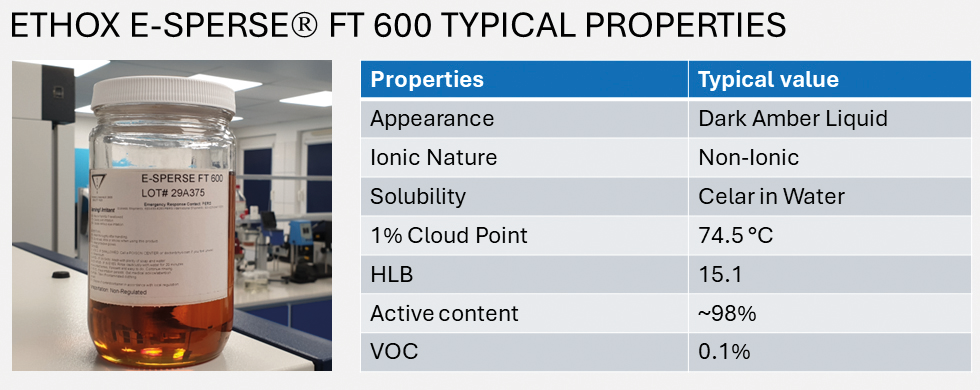
The solution to protecting latex paints against accidental and uncontrolled freezing is the E-Sperse® FT 600 additive from Ethox Chemicals, LLC in South Carolina. It is a surfactant providing excellent wetting and dispersing properties, which, thanks to the stabilization of pigment and filler particles and, above all, the stabilization of polymer particles in the binder, protects latex paints against failure caused by freezing-thawing. The additive is also recommended as an additive to extend the open time and wet edge. The basic characteristics of the technical properties are shown in Figure 3.

Case studies
To demonstrate the performance of the additive in a latex paint formulation, case studies were carried out using it in The Spektrochem Lab, as an independent technical center providing knowledge about raw materials and waterborne paint recipes. For this purpose, a latex paint formulation PVC 26% based on 100% acrylic polymer latex was developed, in which the effectiveness of E-Sperse® FT 600 as a freeze/thaw additive was checked. The formulations were prepared as a base for a tinting medium. The paints were prepared by mill-base grinding by Cowles-dissolver containing fillers and titanium dioxide in a vehicle (with additives, e.g. wetting and dispersing additives, in-can preservative, defoamer), which were combined in the let-down process with an acrylic binder and other additives (e.g. thickeners). The additive was added to the paints in amounts of 1%, 3%, and 5% by weight based on the total formulation, and the dosing was carried out at the let-down stage before the final viscosity adjustment using rheological additives. A control sample without E-Sperse® FT 600 was also prepared for comparison.

ASTM D2243 freeze/thaw test
To assess the freeze/thaw resistance of waterborne paints, the standard test method ASTM D2243-20 Standard Test Method for freeze/thaw resistance of water-borne coatings is used, in which liquid paints in 16 US fl. oz. resin-lined metal cans are placed at 0° F and then thawed at 73.5° F in the lab, thus subjecting them to 5 freeze/thaw cycles.
After completion, the samples are assessed with a rating from 0 to 10, where 0 means complete failure and 10 means no failure (good consistency paint that can be measured on a Stormer Viscometer).
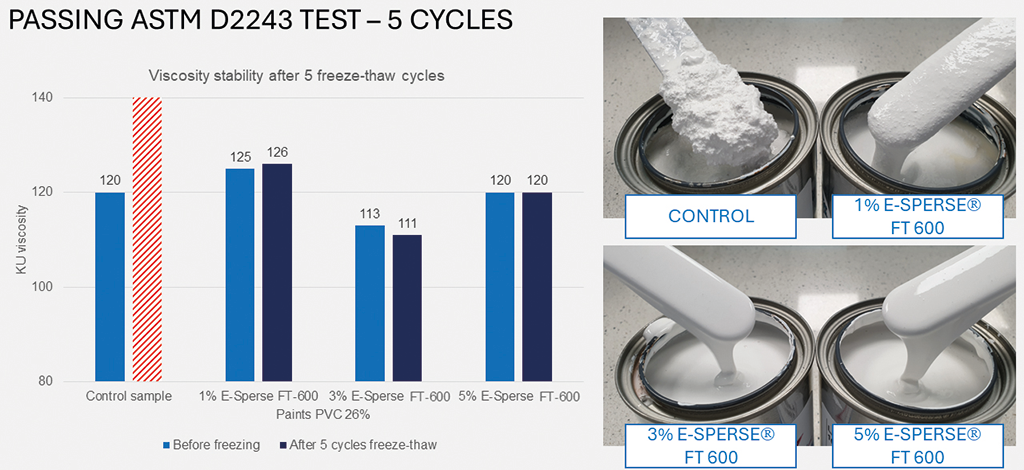
As can be seen in the graph and photo in Figure 4, the control sample shows a failure caused by 5 freeze/thaw cycles, which makes viscosity measurement impossible. The control sample is clearly damaged.
However, if we analyze the photos of samples from E-Sperse® FT 600, we can see that the addition of 1% to 5% improves the freeze/thaw resistance. Paints with 1% E-Sperse® FT 600 after 5 freeze/thaw cycles, however, contain coagulates visible on the spatula, however, the viscosity can be measured and changes in viscosity are imperceptible compared to the sample not subjected to freeze/thaw cycles. In the case of samples with the additive at a dose of 3% and 5%, the absence of coagulants is visible, and the viscosity of the samples is also practically unchanged when comparing paints after 5 freeze/thaw cycles and paint samples not subjected to testing (Fig. 4).
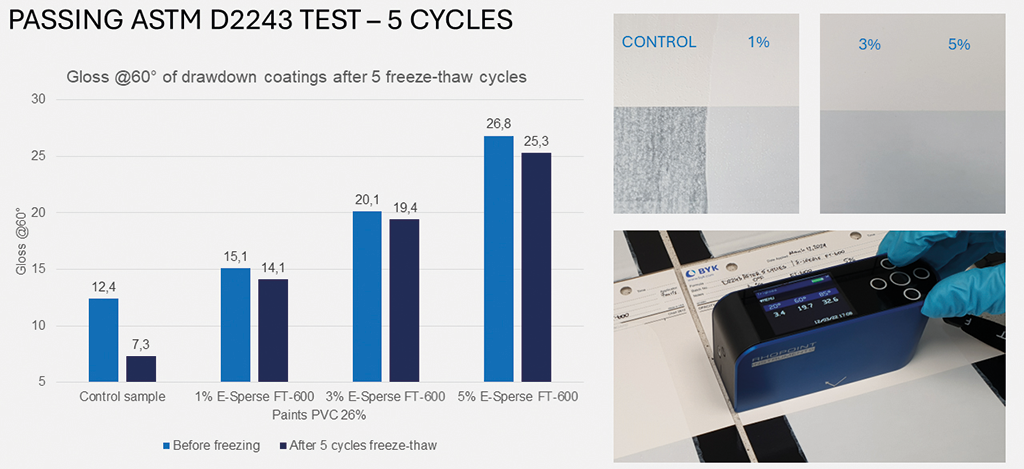
To extend the scope of assessment of the impact of 5 freeze/thaw cycles and the additive on paint coatings, the gloss of paint coatings was assessed before and after 5 freeze/thaw cycles. For this purpose, coatings were obtained from samples by automatic drawdown on BYK cards, which after conditioning at 73.5 °F and 50% relative humidity for 3 days, the gloss at 60° C was measured using a Rhopoint Novo-gloss Trio gloss meter. The results are shown in Figure 5.
Fig. 5
As shown in Figure 5, coagulum in the control sample is still visible on the coating, which also explains the significant reduction in the gloss of the coatings after 5 freeze/thaw cycles. Paint coatings with E-Sperse® FT 600 at a dose of 1% have moderate inclusions and low gloss. Paint coatings with the additive at a dose of 3% and 5% do not have inclusions or coagulum, which shows that the performance of this additive also allows you to maintain a smooth coating. Interestingly, it can be noticed that the surfactant significantly increases the gloss of the coatings as the dose in the formulation increases. Comparing the results of the influence of the given 5 cycles of freeze/thaw resistance on gloss changes, the additive protects paints from damage against freeze/thaw and maintains the original gloss of the coatings, additionally, the property of the additive can be used to control gloss when formulating recipes.
Conclusions
In summary, E-Sperse® FT 600 is a great addition to latex paints to make them resistant to freeze/thaw, especially in the winter when it is difficult to control unpredictable situations with the potential effect of freezing the paints and their failures.
This additive allows preventive protection of latex paints against failure caused by freeze/thaw and can also be used as a gloss regulator to increase the gloss of coatings and as an open time/wet edge extender.