High-performance polyurethane dispersions for premium wood coatings

Annika Bartuschat – WORLÉE

Polyurethane  dispersions (PUDs) have been proven for many years in a variety of applications and have become an essential component in modern formulations for coatings and adhesives.
Thanks to their polymeric structure, polyurethanes offer a broad range of customization options, allowing the development of tailored property profiles for diverse requirements.
Users across different industries particularly appreciate their outstanding mechanical properties.

Polyurethane dispersions for high-quality applications
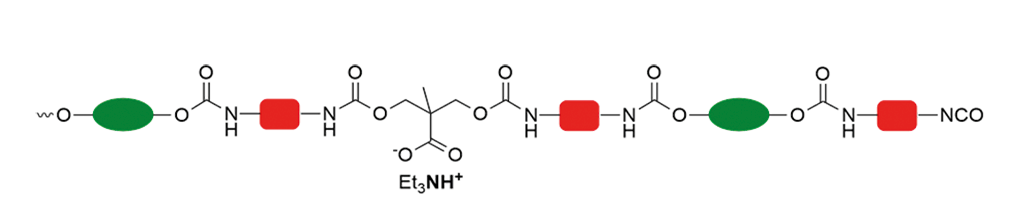
The main components of polyurethane dispersions – polyol and diisocyanate – can be combined in a modular system, enabling precise property adjustments. By varying the type and structure of individual components, tailor-made properties can be achieved (Fig. 1).

Fig. 1 – Schematic of a polymer chain of diol and diisocyanate


Fig. 2 – Schematic of a polymer chain with hard and soft segments


Due to the specific structural arrangement of polymer chains into soft and hard segments, polyurethane films exhibit unique properties that are unmatched by other binder classes.
The hard segments, consisting of RNCO units, are embedded within the matrix of the soft segments, composed of polyol chains, contributing to superior mechanical performance.
These unique structural characteristics offer significant advantages:

– high hardness without brittleness.

– Exceptional flexibility without a soft or sticky feel.

– Excellent chemical resistance through targeted polyol selection.

As a result, polyurethane dispersions are particularly suited for high-quality coatings, such as parquet and furniture lacquers, which must withstand high mechanical stress from abrasion and scratches. The coating must balance toughness and elasticity to prevent defects while offering excellent resistance to household chemicals. Polyurethane dispersions also enable the production of highly flexible films with excellent tensile strength for plastic applications or leather coatings.

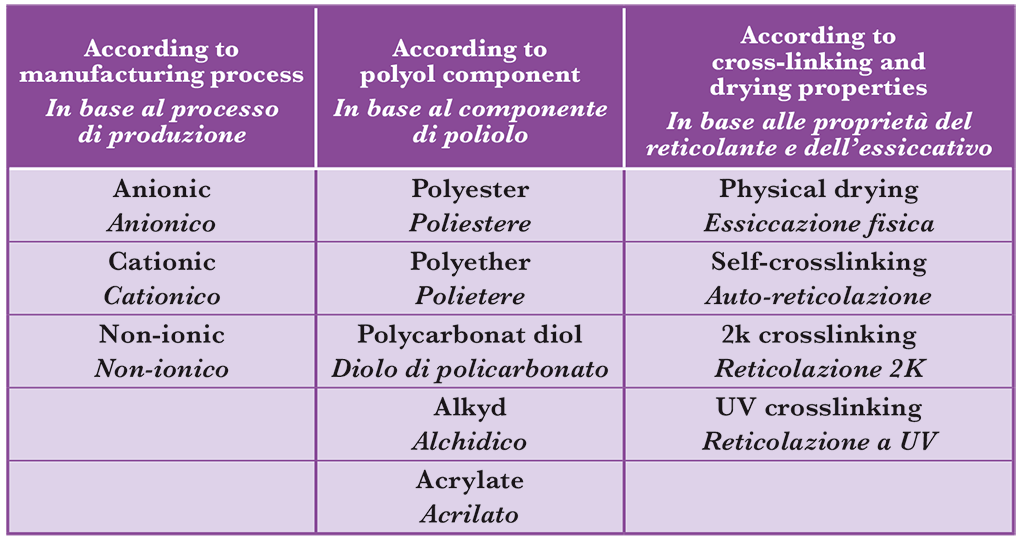
Tab. 1 – Differentiation criteria for polyurethane dispersions

At the same time, the polymer maintains high durability, ensuring long-term protection. Skillful selection of polyols allows for excellent adhesion properties, even on challenging substrates. Additionally, polyurethane dispersions are widely used in adhesive formulations, providing strong adhesion and high resistance to mechanical and chemical stress – making them an ideal solution for industrial adhesive applications. Polyurethane dispersions can be classified based on various criteria.
Depending on the production process, they can be categorized as anionic or cationic PUDs. The choice of polyol components, as well as crosslinking and drying properties, also play a key role in characterization (Tab. 1).

WorléePUD VP 1011 for high-performance coating systems
WorléePUD VP 1011 offers exceptionally high scratch and abrasion resistance, making it ideal for coatings subjected to high mechanical stress. The resulting film also exhibits excellent resistance to household chemicals such as alcohol and cleaning agents, as well as very good water resistance.
This makes the product suitable for demanding flooring applications, such as parquet varnishes. At the same time, the binder contains a high proportion of bio-based raw materials, approximately 48% (based on the binder solids).
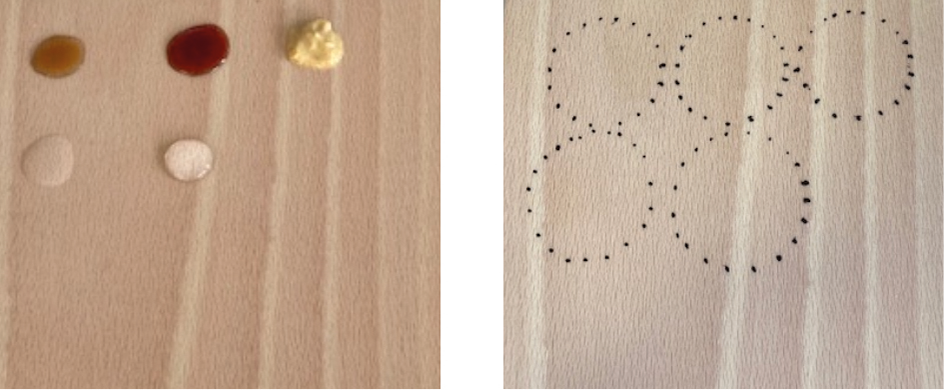
Performance was tested in accordance with DIN 68861-1:2001-04. Substances tested included coffee, red wine, mustard, ethanol (40%), and water – with very good results. The film also demonstrated excellent resistance to cosmetic products such as creams (e.g., Nivea).
In addition to its high chemical and mechanical resistance, WorléePUD VP 1011 also performs well in high-quality furniture coating systems where fast drying and high blocking resistance are required.
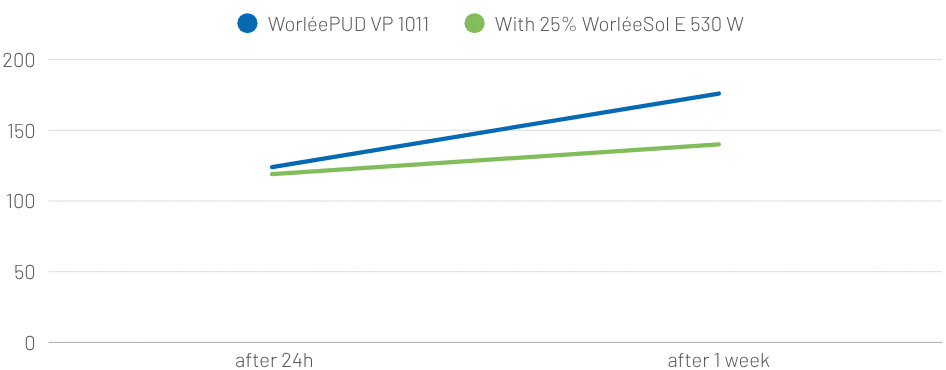
To reduce the co-solvent content, formulations based on WorléePUD VP 1011 can be combined with PU alkyd emulsions, such as WorléeSol E 150 W or WorléeSol E 530 W. Up to 25% of the PUD can be replaced without losing the characteristic PUD properties of the formulation. Performance remains largely unchanged: pendulum hardness decreases only slightly, while abrasion resistance and blocking resistance remain at comparable levels. This opens up additional formulation flexibility while maintaining the system ’s high performance.

WorléePUD VP 2011 CA – Camelina Oil-Modified for Sustainable Coatings
WorléePUD VP 2011 CA contains camelina oil and offers a sustainable solution for a variety of coating applications. The raw material is derived from the resilient camelina plant (Camelina sativa), which grows quickly and provides high yields. Regional cultivation reduces the carbon footprint by eliminating long transportation routes.


Fig. 3 e 4 – Exposure to coffee, red wine, mustard, ethanol (40%) and water (from left to right, top bottom) and results after 16 hours of exposure


Camelina oil stands out as a resource-efficient raw material that is produced without competing for land with the food industry. From a technical standpoint, it excels due to its high elasticity and natural resistance to water.
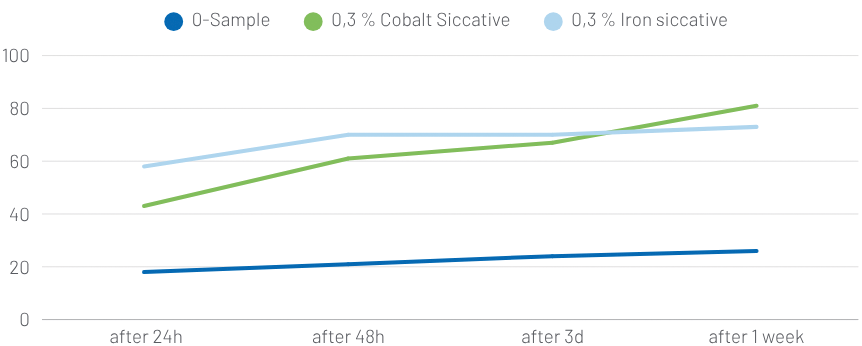
It can be used in both aqueous and solvent-based binders and supports biodiversity while reducing pesticide use through mixed crop cultivation. This makes it a sustainable and regional raw material for innovative, eco-friendly applications. By adding various siccatives, it has been shown that the oxidative drying of WorléePUD VP 2011 CA can be specifically improved.

WorléePUD VP 4011 for 1K and 2K Applications with Excellent Adhesion to Plastics
WorléePUD VP 4011 is particularly suitable as an adhesion primer for plastics, providing excellent adhesion results on materials such as ABS, PS, PMMA, and PVC. Outstanding adhesion has also been achieved on metals such as bright or sendzimirgalvanized steel and aluminum. Crosslinking with polyisocyanates significantly improves solvent resistance and water resistance.

Diagram. 1 – Hardness development (pendulum hardness according to König in s) with and without 25% WorléeSol E 530 W


Diagram. 2 – Oxidative drying with different siccatives


WorléePUD VP 5011 for high-quality wood coatings
WorléePUD VP 5011 is an acrylated polyurethane dispersion for high-quality wood coatings. The binder forms very hard, abrasion-resistant films and is characterized by high scratch resistance as well as good chemical resistance.
This makes WorléePUD VP 5011 particularly suitable for applications with high mechanical demands, such as wood furniture coatings, parquet coatings, and other floor coatings.
In addition to its high mechanical strength, the product offers good resistance to water and alcohol. At the same time, the self-crosslinking structure ensures robust and nonblocking coatings.
Another advantage is the high proportion of renewable raw materials, approximately 57% (based on the binder solids), making WorléePUD VP 5011 particularly suitable for more sustainable coating systems.

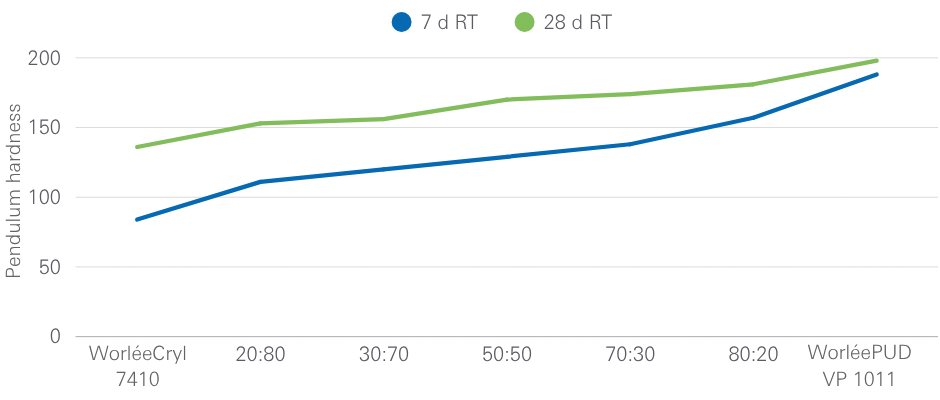
Diagram. 3 – Hardness development (pendulum hardness according to König in s) after mixing WorléeCryl 7410 with WorléePUD VP 1011 in various ratios


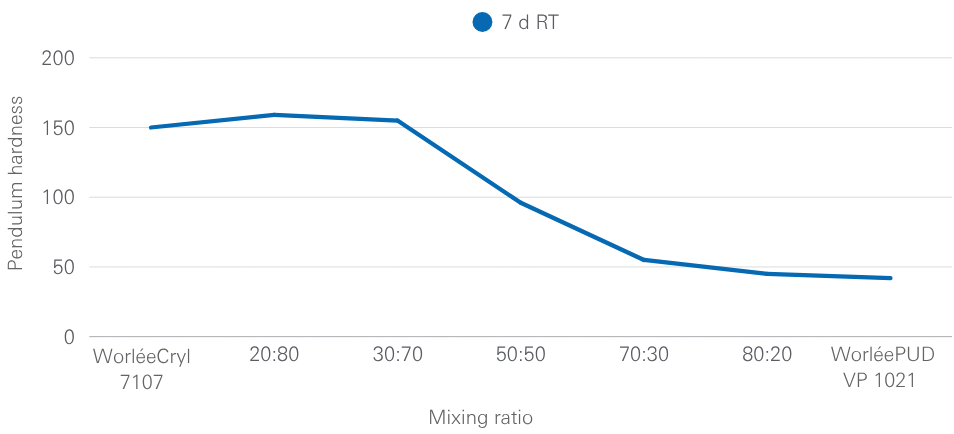
Diagram. 4 – Hardness development (pendulum hardness according to König in s) after mixing WorléeCryl 7107 with WorléePUD VP 1021 in various ratios


Typical properties:

  • very hard and abrasion-resistant films.
  • Good scratch and chemical resistance.
  • Good resistance to water and alcohol.
  • Non-blocking
  • Approx. 57% bio-based raw materials (based on solids).

WorléePUD – acrylate hybrid systems
A widely used method in the development of coating formulations is the combination of polyurethane and acrylate dispersions. By mixing them, positive properties of both binder classes can be combined in many cases. For example, hardness and blocking resistance can be increased by combining softer acrylates with harder polyurethane dispersions in order to create a more resistant coating film (Diagram 3).
Conversely, even very brittle and hard acrylic coatings can be made more flexible by cleverly combining them with elastic polyurethane dispersions without negatively affecting the blocking resistance (Diagram 4).

Conclusion: tailored performance for next-generation coatings
The WorléePUD portfolio demonstrates that high-performance mechanical properties and ecological responsibility can go hand in hand. Through a modular system of polyols and diisocyanates, these polyurethane dispersions offer tailored profiles ranging from extreme scratch resistance for wood and flooring to high elasticity for leather and plastics. By integrating renewable raw materials – such as camelina oil – and offering versatile hybrid options with acrylates, Worlée provides formulers with the flexibility needed for modern, sustainable applications. Ultimately, these PUDs represent a future-oriented solution for industries demanding durability, chemical resistance, and a reduced environmental footprint.