Aina Pérez, Tessa Faulks and Marc Comì – VITO
The coatings industry is entering a decisive moment, driven by the need to replace bisphenol-based epoxy systems without compromising performance. For decades, BPAbased resins have been the backbone of protective coatings in construction and industrial environments, valued for their durability, chemical resistance and mechanical strength. Yet their environmental and health impacts, combined with tightening European regulations, are pushing manufacturers to seek safer and more sustainable alternatives. In this context, VITO has emerged as a leading European reference for BPA-free epoxy solutions, demonstrating that renewable chemistry can deliver the same reliability as traditional systems while opening the door to new material innovations.
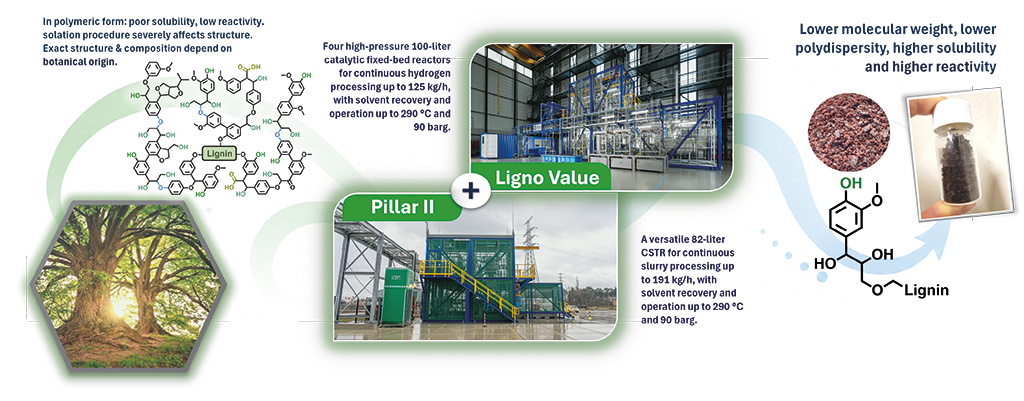
At the heart of the work is lignin, one of the most abundant renewable aromatic resources on the planet. Produced in large volumes as a byproduct of the pulp and biorefinery sectors, lignin is typically burned for energy despite its rich chemical potential.
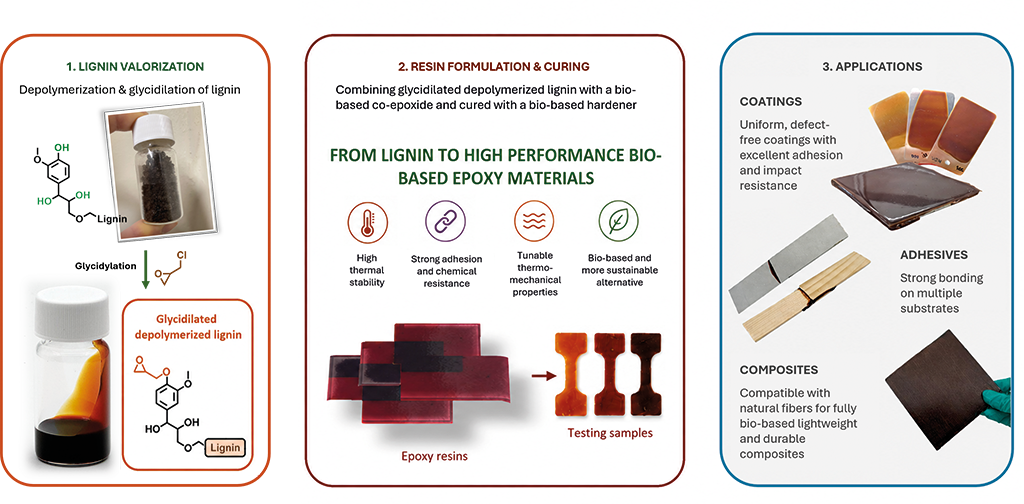
VITO’s research infrastructure, including its pilot-scale depolymerisation facilities, enables lignin to be transformed into smaller, reactive aromatic molecules. Through glycidylation, these molecules become epoxy-functional building blocks capable of replacing bisphenol derivatives in resin formulations. This approach creates a fully biobased, BPA-free epoxy platform that can be tuned to meet the performance requirements of modern coatings. What makes this development particularly relevant for the coatings sector is the versatility of the resulting materials.
Lignin-based epoxy resins can be formulated with different co-epoxides and curing agents, allowing manufacturers to adjust viscosity, curing behaviour, crosslink density and surface properties. This means that the final performance is not fixed by the raw material itself but shaped by formulation design, just as in conventional epoxy chemistry.

In practice, the company has shown that these bio based systems can be applied on metal, concrete and wood substrates using standard industrial equipment. The resulting films are uniform, defect-free and visually comparable to traditional epoxies, with strong adhesion, high thermal stability and robust chemical resistance. For manufacturers, this demonstrates that sustainability does not require sacrificing performance or changing existing application processes.
A key element of the approach is the integration of Safe and Sustainable by Design principles. Each formulation undergoes eco-toxicological assessment and life cycle considerations to ensure that the materials developed are not only high performing but also aligned with future regulatory expectations. This combination of technical excellence and responsible innovation gives companies confidence that the solutions they adopt will remain viable in a rapidly evolving regulatory landscape. It also positions VITO as a trusted partner for industries seeking to transition away from hazardous substances while maintaining product quality and market competitiveness.
The official conclusion of the LEGACY project marked an important milestone in this journey. Supported by NextGenerationEU through the Belgium Builds Back Circular programme, as part of the National Plan for Recovery and Resilience, the project aimed to provide safer alternatives to substances of concern and accelerate the adoption of circular materials in industry.

Through this initiative, the Belgium Institution validated the scalability and industrial relevance of lignin-based epoxy coatings, confirming that bio-based alternatives can match the functional requirements of BPA-based systems. The project’s outcomes strengthened VITO’s position as a European leader in BPA-free epoxy innovation and demonstrated that renewable feedstocks can be successfully integrated into high performance coating technologies.
Although the project has ended, the momentum it created continues to grow, and VITO is now actively supporting companies interested in adopting or co-developing these new materials. In parallel to the work on coatings, the research center has also demonstrated that lignin-based epoxy systems perform strongly in adhesives and composite applications. Bonding tests on metal, concrete and wood assemblies show cohesive and durable performance, while composite matrices based on lignin-derived epoxies offer lightweight and robust structures compatible with natural fibres such as flax and hemp. These results highlight the broader potential of lignin-based epoxies beyond coatings, offering companies additional pathways to integrate safer and more sustainable materials into their product portfolios.
VITO welcomes collaboration to explore these opportunities and to accelerate the transition toward circular, high performance materials that meet the demands of tomorrow’s markets.