Ana Mangas – AIMPLAS
The need to develop more sustainable flame-retardant materials is now a real technological priority rather than a mere trend. Sectors such as construction, technical furniture, transport, and advanced interior design demand coatings capable of reducing fire spread, limiting heat release, and minimizing smoke emissions, especially when applied to combustible substrates such as wood or wood-based panels.
However, these performance requirements must coexist with an increasingly restrictive regulatory and environmentalframework, where it is no longer enough for an additive to be effective against fire: it must also align with chemical safety criteria, emission reduction, efficient use of resources, and, where possible, the incorporation of renewable raw materials. This paradigm shift is profoundly transforming the development of flame retardants. Traditionally, many flame-retardant systems have relied on petrochemical raw materials, solution-based synthetic routes, and manufacturing processes intensive in solvents, energy, and purification steps.
Although these technologies have enabled the production of high-performance functional additives, they present significant limitations from the perspective of industrial sustainability. Solvent consumption, waste generation, variability associated with multi-step processes, and the difficulty of achieving clean, continuous scale-up are factors that now decisively affect the viability of new solutions.
In this context, sustainability in flame-retardant materials must be understood in a dual dimension. On the one hand, there is the sustainability of the material itself – the possibility of designing flame retardants from partially or fully bio-based precursors or at least reducing dependence on conventional fossil-based building blocks. On the other hand, there is the sustainability of the manufacturing process, which involves rethinking synthesis from the perspective of process intensification, operational simplification, and environmental impact minimization. It is precisely in this second aspect where mechanochemistry is gaining increasing interest as an advanced synthesis route.

Mechanochemistry allows chemical reactions to be induced through mechanical energy, avoiding or drastically reducing the use of solvents and enabling more compact, faster, and potentially scalable processes. Although it has been traditionally perceived mainly as a laboratory tool, its integration into continuous technologies such as twinscrew extrusion is now opening an especially attractive scenario for the production of functional additives at preindustrial and industrial scale. Within this framework lies the REFUGI project, aimed at developing sustainable phosphorus-based flame retardants obtained through continuous mechanosynthetic routes and validated in varnish formulations applied to wood substrates.
From laboratory mechanochemistry to continuous synthesis in reactive extrusion
In this context, one of the major challenges is not only identifying new molecules with flame-retardant potential but also finding manufacturing routes that allow them to be produced in a cleaner, more robust, and more transferable way. This is where mechanochemistry begins to gain particular relevance. Compared to conventional synthetic approaches based on liquid media and longer process sequences, mechanical activation enables the generation of functional materials from a different logic: reduced solvent dependence, fewer intermediate steps, and greater compatibility with continuous production schemes. This shift becomes especially significant when mechanochemistry moves beyond the laboratory and is integrated into continuous processing technologies with clear industrial potential. Twin-screw reactive extrusion represents, in this regard, a particularly attractive platform, combining intensive mixing capability, thermal control, process continuity, and scalability. Applied to the development of flame retardants, this approach not only allows the exploration of new synthesis routes but also brings the resulting materials closer to real formulation and application environments. Within this framework, the REFUGI project focuses on developing sustainable phosphorus-based flame-retardant additives through a continuous mechanosynthetic strategy and validating them in varnish coatings for lignocellulosic substrates. Beyond the chemical interest of the compounds obtained, the value of the approach lies in demonstrating that functional materials can be produced through an intensified manufacturing route with clear scalability potential and subsequently evaluated for their fire performance in practical systems.
Using this platform, different families of phosphorus and phosphorus–nitrogen-based materials were developed, including partially or fully bio-based compositions. The aim was not only to obtain new additives but also to determine whether they could deliver competitive fire performance once incorporated into real varnish formulations. In other words, the goal was not to demonstrate improvements in isolated tests on synthesized powders, but to validate a complete technological proposal: functional origin of the additive, sustainable manufacturing process, and final performance in application.
Sustainbale frame-retardant materials: from chemical design to end use
One of the most relevant aspects of the work is that sustainability was addressed holistically. On the one hand, chemical building blocks with high flame-retardant functionality were explored, in several cases with renewable or partially renewable origin. On the other hand, the production process was conceived from the outset as an alternative to more solvent-intensive routes and postprocessing operations.

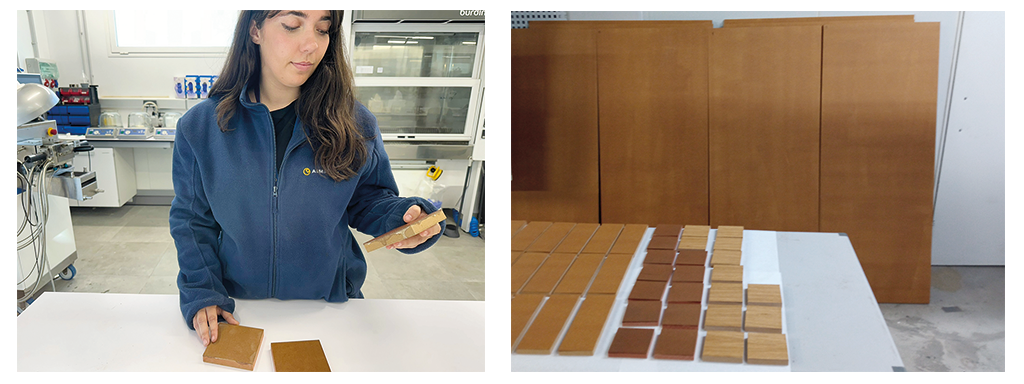
This combination is particularly interesting because it enables progress toward additives that are not only effective but also consistent with current requirements for responsible manufacturing.Ho wever, in the field of flame retardants, the decisive criterionremain s real performance under use conditions. For this reason, the materials developed in REFUGI were incorporated into solvent-based varnishes and applied to MDF panels, a highly representative substrate due to its widespread use in interior construction, furniture, and cladding. This validation phase was essential, as the fire response of an additive depends not only on its chemical nature but also on its interaction with the matrix, its dispersion, compatibility, and the way it contributes to forming protective barriers during combustion.
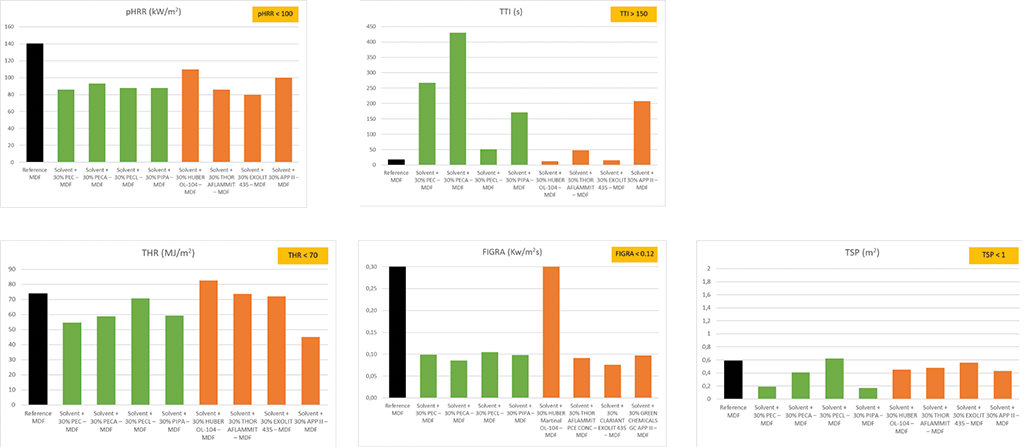
The results obtained show that several of the developed formulations achieve highly competitive performance compared to commercial references tested within the same system. In particular, some families exhibited peak heat release rate (pHRR) values in the range of 85–90 kW/mÇ, along with FIGRA values around 0.09–0.10 kW/m²·s, indicating a clear reduction both in maximum fire intensity and in fire growth rate. Additionally, there was a significant reduction in sustained heat release, reflected in low MARHE values, as well as particularly low smoke production in several compositions.
This last aspect is especially important. In many real scenarios, smoke is one of the most critical safety factors, not only because of its potential toxicity but also due to reduced visibility and its direct impact on evacuation times. In this regard, some REFUGI formulations showed total smoke production (TSP) values much lower than those observed in commercial reference solutions, while maintaining competitive pHRR and FIGRA levels. This is a particularly valuable combination, as a good thermal severity response is not always accompanied by equally significant emission reductions.
Results beyond peak heat reduction
Another noteworthy result was the behavior observed in terms of ignition delay and the temporal shift of the peak heat release. Some formulations showed clearly increased ignition times and a significantly delayed peak heat release, suggesting a capacity not only to reduce fire intensity but also to slow its development. From a safety perspective, this effect can be as relevant as the reduction of the thermal peak itself, as it provides an additional time window for detection, response, or evacuation. Furthermore, several compositions exhibited zero mass loss during the test. This indicates the formation of a stable protective residue capable of acting as a physical barrier against heat propagation and mass transfer. In the context of coatings on wood, this behaviour is particularly interesting because it suggests that the system does not merely act as a dispersed additive but actively contributes to forming an effective protective structure during thermal exposure.
Among the different families studied, distinct performance profiles were observed. Some compositions stood out due to a well-balanced combination of low pHRR, low FIGRA, and reduced smoke; others showed particularly outstanding performance in terms of ignition delay or reduction of sustained heat release. This internal diversity is, in fact, one of the strengths of the work, as it demonstrates that the developed platform does not lead to a single closed solution but rather to a family of materials that can be tailored according to application requirements.
Technological relevance and potential impact
The interest of these results lies not only in achieving strong fire performance data, but in the fact that these results stem from a strategy that combines functional chemical design, sustainable manufacturing, and compatibility with real formulations. In other words, the project demonstrates not only that flame retardants can be synthesized via continuous mechanosynthetic routes, but also that these materials can be integrated into varnishes applicable to industrial substrates and compete with existing market solutions. This has important implications at several levels. From a process perspective, it reinforces the idea that mechanochemistry can move beyond the academic sphere and become a real manufacturing tool for functional additives. From a product perspective, it opens the door to flame retardants with a potentially lower process footprint and the possibility of incorporating biobased raw materials. From a sectoral perspective, it provides a promising pathway for developing next-generation coatings in applications where fire safety is critical, but so are sustainability, aesthetics, and compatibility with existing industrial lines.
In summary, REFUGI shows that the development of sustainable flame retardants should no longer be understood as a mere substitution of raw materials, but as a complete redefinition of the value chain, from synthesis to final application. The combination of continuous mechanochemistry, phosphorusbased functional building blocks, and validation in varnishes for wood enables progress toward solutions that more coherently meet current technological demands: safer materials, cleaner processes, and a much closer path to industrial implementation.
The project is part of the IVACE+i funding program aimed at technology centres in the Valencian Community for noneconomic R&D projects carried out in collaboration with companies for the 2024 call, financed by the European Regional Development Fund (ERDF) of the European Union within the 2021–2027 Operational Programme.
Refernces
1 MDF (Medium Density Fiberboard): a medium-density wood fiberboard obtained by defibration and pressing with resins, used as a lignocellulosic substrate in fire reaction tests.
2 pHRR (peak Heat Release Rate): maximum value of the heat release rate (kW/mÇ) during combustion, indicating the peak intensity of the fire.
3 FIGRA (Fire Growth Rate Index): index that relates the rate of fire development to heat release; the lower the value, the lower the contribution to fire growth.
4 MARHE (Maximum Average Rate of Heat Emission): maximum average rate of heat emission over the course of the test, a parameter representing the overall severity of the fire.
5 TSP (Total Smoke Production): total amount of smoke generated during combustion (mÇ), associated with smoke load and visibility during a fire.