Renewable FDCA-based resins for coil coatings

Nataša Čuk, Martin Ocepek, Jaka Langerholc, Peter Venturini  – HELIOS RESINS

2,5-furandicarboxylic acid (FDCA) is a renewable organic compound that consists of two carboxylic groups attached to furan ring. In general, it is derived from dehydration of polysaccharides via oxidation of 5-hydroxymethylfurfural (HMF) and can be used to replace fossil-based terephthalic and isophthalic acid.
One of the most widely investigated use of FDCA is in poly(ethylene 2,5-furandicarboxylate) (PEF), a renewable alternative to poly(ethylene terephthalate) (PET). Other applications include other polyesters, alkyds, polyamides, epoxies, polyurethanes, fire-retardants, nanocomposites, elastomers, etc. Additionally, the potential use of 2,5-FDCA esters has also been investigated.
The goal of our research was to synthesize industrial sustainable resin for coil coatings with increased share of renewable components. This was done by replacing terephthalic and isophthalic acid in our standard industrial resin formulation with FDCA where the properties of renewable resins and coatings would be comparable to its standard counterparts in terms of mechanical and physical properties.
Resins with 1-31% of FDCA on polymer were synthesized and their properties in industrial chromate-free polyester coil coatings were validated and compared to standard resin Domopol 5174 which is saturated polyester resin and is commercially produced by Helios Resins.
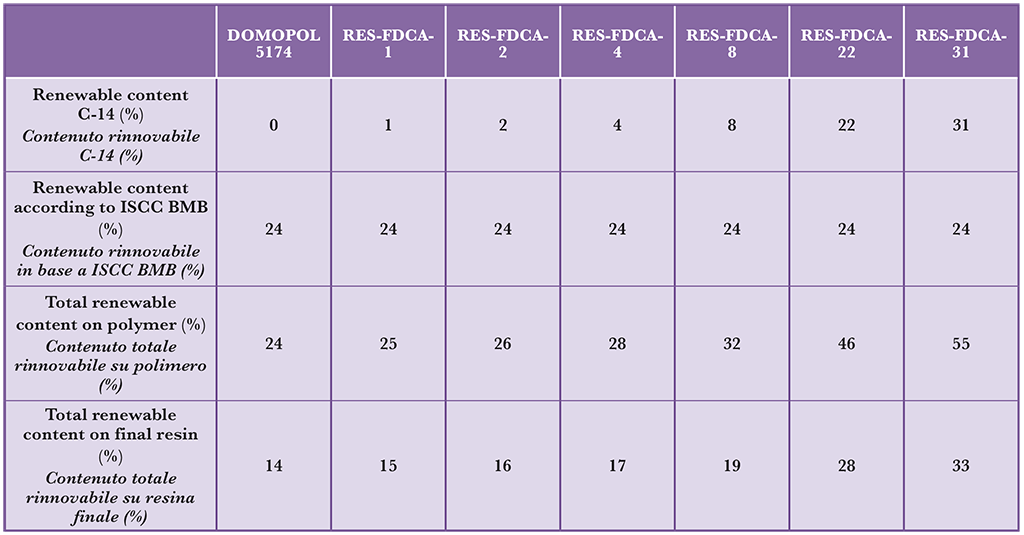
For all resins renewable content was calculated consisting of renewable content according to C-14 method (according to ASTM 6866) and renewable content according to biomass balance (BMB) approach as certified by the International Sustainability and Carbon Certification (ISCC PLUS). In Table 1 total renewable content on polymer and on final diluted resin are shown.
Renewable content according to BMB is 24% in all resins, while the renewable content according to C-14 varies from 0% in standard resin with no FDCA in the formulation up to 31% in resin with 31% of FDCA on polymer in the formulation.
Total renewable content on polymer spans from 24% in standard resin up to 55% in resin with the highest amount of FDCA in the formulation, while total renewable content on final resin ranges from minimum of 14% up to maximum of 33%.

Tab. 1 – Renewable content of standard (Domopol 5174) and FDCA-based resins

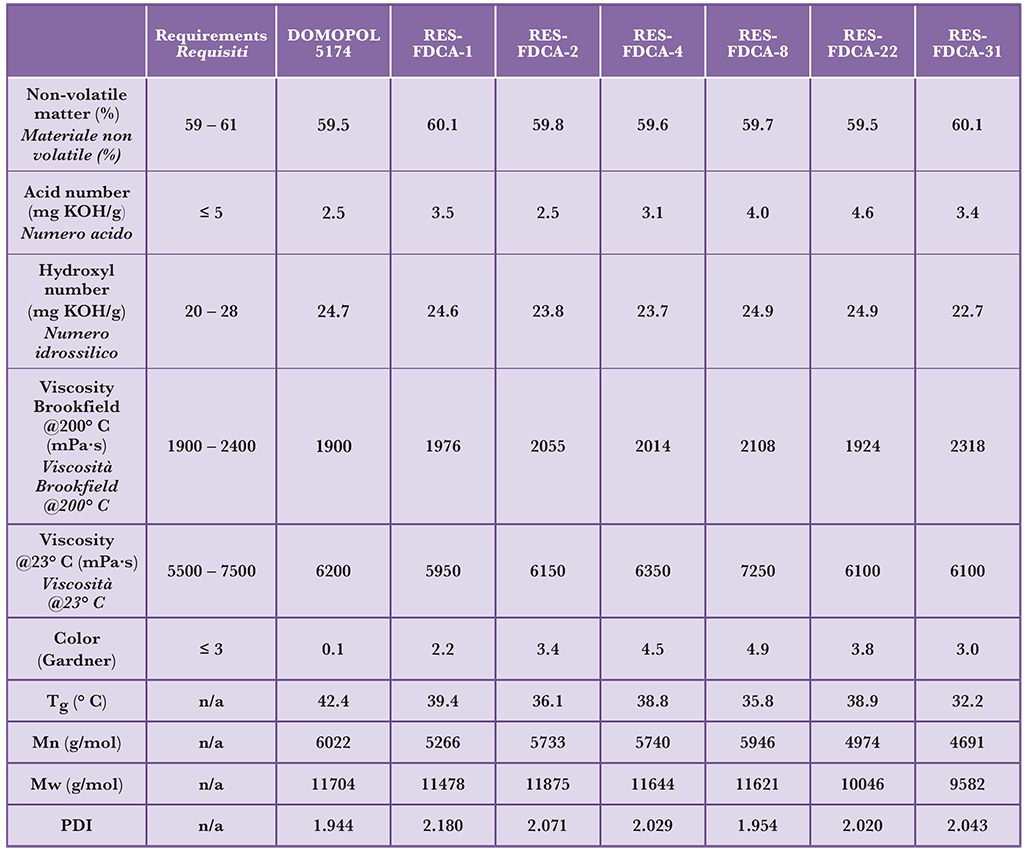
The properties and the appearance of standard and FDCA-based resins are summarized in Table 2 and Figure 1. Additionally, in Table 2 the requirements for polyester resins for coil coatings are stated. All synthesized resins had acid value, hydroxyl value and viscosity in the range as required, while color of the resin strongly deteriorated with increasing amount of FDCA in the formulation from 0.1 Gardner for standard resin to 4.9 Gardner for resin with 8% of FDCA on polymer.
Since standard resin and resins with 1 – 8% of FDCA on polymer were synthesized at the temperature of 240° C, the color deterioration can be attributed to the decarboxylation of FDCA which appears at temperatures higher than 220° C and gives side products that contribute to the high color of the resin.
In addition to dark color, resin with 8% of FDCA on polymer was hazy and that was due to incompatibility with solvents used for the dilution of the resin (solvent naphtha and methoxypropyl acetate). For the resin to become clear the ratio of the solvents had to be adjusted in a way that it consisted of less solvent naphtha and more methoxypropyl acetate.
To mitigate the discoloration of the resin the temperature of the synthesis was lowered to 200° C. At this temperature the solubility of the terephthalic acid becomes very poor and for this reason all terephthalic acid was replaced with FDCA corresponding to 22% of FDCA on polymer. Additionally, 50% of isophthalic acid was replaced with FDCA, corresponding to 31% of FDCA on polymer.
The color of the resins synthesized at 200° C was strongly improved compared to the resins synthesized at 240° C and as lower when besides terephthalic acid isophthalic acid was replaced with FDCA as well.

Tab. 2 – Properties of standard resin (Domopol 5174) and resins with 1 – 31% of FDCA on polymer

Nevertheless, these two resins were diluted with only methoxypropyl acetate, since even a small amount of solvent naphtha induced incompatibility and the resin became hazy. Resins with up to 8% of FDCA on polymer exhibited similar molecular weights, slightly higher polydispersity index and lower Tg compared to standard resin, while resins with 22% and 31% content of FDCA on polymer also showed lower Tg and slightly higher polydispersity index but lower molecular weights compared to standard. Some authors attribute lower molecular weights when using FDCA to its decarboxylation to 2-furancarboxylic acid which acts as chain stopper and limits the molecular weight build-up. However, viscosity was not following that trend.

Fig. 1 – Appearance of standard resin (Domopol 5174) and resins with 1 – 31% of FDCA on polymer

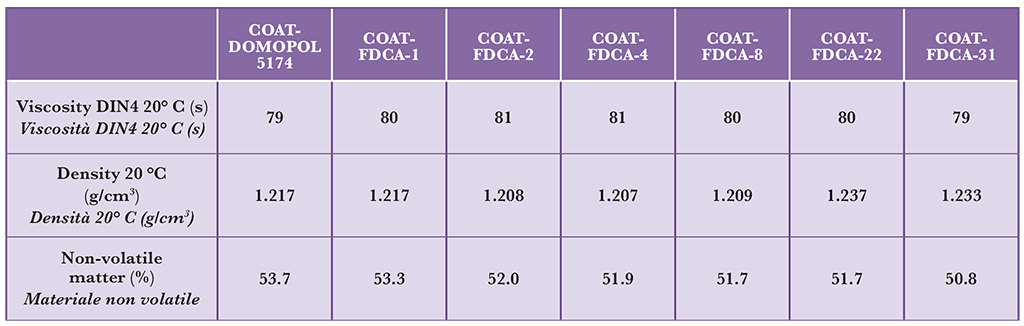
In Table 3 properties of liquid resins are presented. It can be seen from the table that viscosity and density of all FDCA-based coatings were comparable to standard resinbased coating. Viscosity spanned from 79 to 81 s and density ranged from 1.207 to 1.237 g/cm3.
On the other hand, the non-volatile matter decreased for coatings with higher amount of FDCA in the resin as compared to standard coating.

Tab. 3 – Properties of liquid coatings made from standard resin (Domopol 5174) and resins with 1 – 31% of FDCA on polymer

Namely, the non-volatile matter of standard resin-based coating was 53.7%, while the non-volatile matter for coating prepared from the resin with the highest FDCA amount, i.e. 31% of FDCA on polymer, was 50.8% corresponding to 5.4% drop.
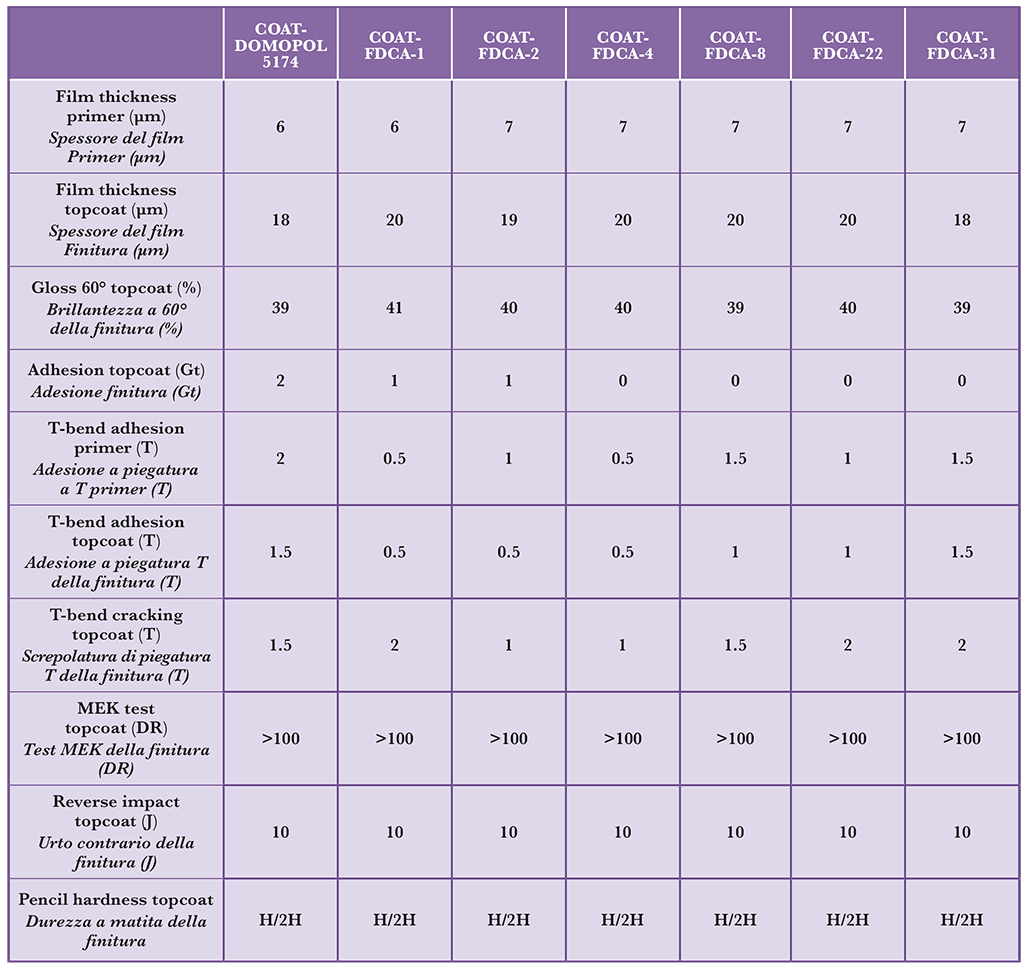
The results of testing of coatings prepared from standard and FDCA-based resins are shown in Table 4. It can be seen from the table that the reverse impact, pencil hardness and MEK test results of FDCA-based coatings are comparable to standard coatings, while the results of adhesion and T-bend test vary between FDCA-based and standard coating.
Adhesion of the coating was improved with increasing content of FDCA in the resin and the same was observed for adhesion in T-bend test, while the results for cracking in T-bend test were somewhat scattered. In this research we showed that FDCA can be used as a renewable replacement for terephthalic and isophthalic acid in polyester resins for coil coating application.
Resins and coatings with the same performance as its standard version can be prepared using FDCA.

Tab. 4 – Properties of coil coatings made from standard resin (Domopol 5174) and resins with 1-31% of FDCA on polymer

Further studies on weather resistance are needed and the use of FDCA-based resins for other applications such as can coatings should be investigated. Furthermore, the use of FDCA esters should be explored.