Rich Czarnecki – MICRO POWDERS
Background
Wax additives are an essential part of any coating formulator’s toolkit. Micronized wax powders, dispersions and emulsions can improve the durability of all types of surface coatings, improving slip and lubricity, abrasion and scratch resistance, anti-blocking, and rub resistance. With emerging regulatory scrutiny regarding PFAS substances, many customers are eliminating the use of PTFE, which is classified as a PFAS substance.
Wax behavior in coatings Wax particles rise to the surface of a liquid coating through a combination of physical and chemical processes during application and drying or curing:
– density.
– Film shrinkage.
– Solubility and compatibility.
– Surface energy effects.
This behavior is intentionally leveraged in coatings, inks, and other formulations to enhance surface properties like slip, gloss control, and abrasion resistance.

Wax chemistry
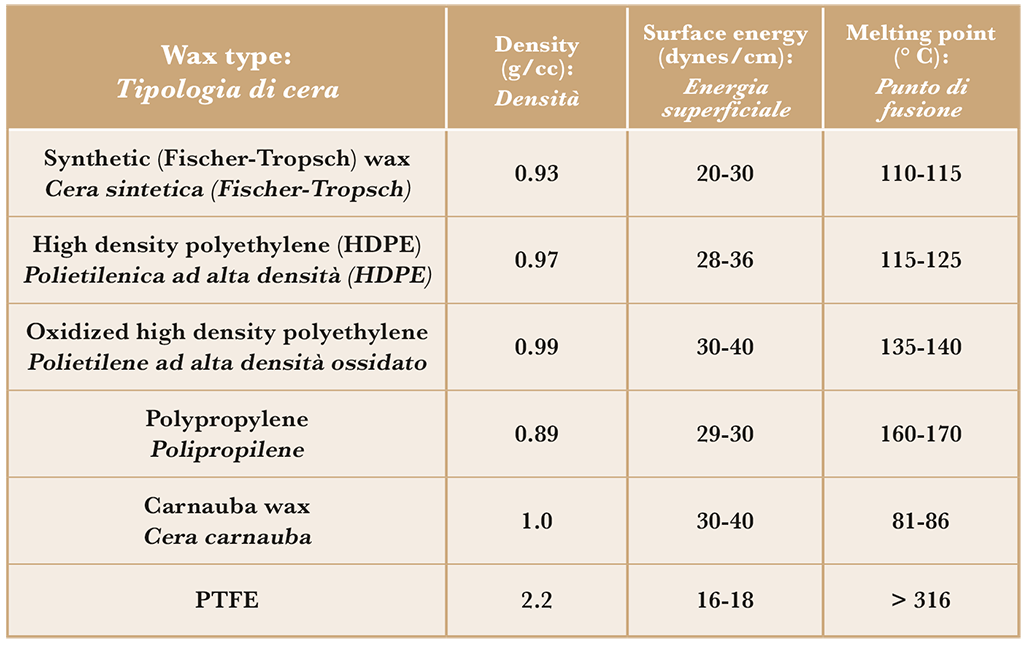
The choice of wax chemistry can affect many performance properties (Tab. 1). One will note that PTFE has properties markedly different from most wax additive chemistries:
– lowest surface energy.
– Highest melting point.
– Highest density.
Some of these properties provide unique performance benefits in a wax additive. PTFE’s very low surface energy makes it an ideal material for imparting a high degree of slip and lubricity.
The high melting point of PTFE enables use in applications where a coating undergoes a baking or oven curing process since it will not melt. Additionally, PTFE is an extremely durable material that can provide those benefits along with improvements in scratch, mar and abrasion resistance. On the contrary, the high density of PTFE significantly impacts the ability of micronized particles to migrate efficiently to the surface of a coating after drying and curing.

Wax composites
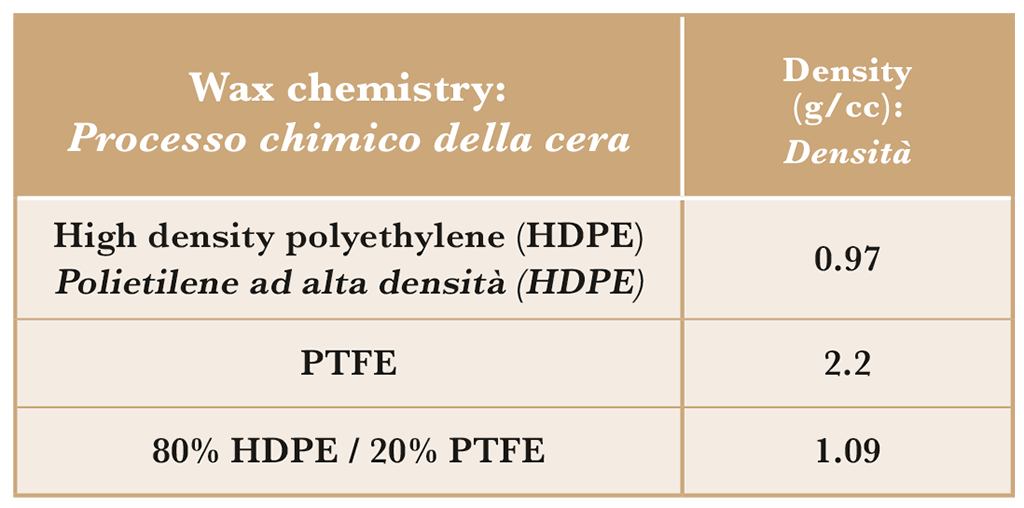
To overcome the high density and poor mobility of PTFE, wax manufacturers developed composite or alloy waxes that combine finely micronized PTFE with other waxes. The most popular permutation of this approach would be a wax composite based on a combination of PTFE and polyethylene wax, typically high-density polyethylene (HDPE).
Such a composite wax is manufactured by blending fine PTFE powder with molten HDPE in a bulk melting or extrusion process. This intermediate composite material is then cooled, crushed and size reduced (micronized) into a fine powder (Tab. 2). PTFE composite waxes have been established as a performance benchmark for decades in the coatings industry.

Replacing PTFE in Composite Wax Additives
PTFE is primarily valued in composite wax powders for the following performance benefits:
– high surface lubricity (low coefficient of friction or COF)*.
– Excellent scratch and abrasion resistance.
– Heat and chemical resistance.
– Anti-blocking.
Fortunately, many other wax additive chemistries can also provide excellent slip and lubricity. The most important performance benefit derived by incorporating PTFE into a wax composite is generally considered to be surface durability.
PTFE composite additive powders can significantly improve the resistance of a coating to damage during application, fabrication, and end use. This includes scratch and abrasion resistance.
If PTFE is no longer a viable component of a wax additive, alternate materials must be identified that can bring a similar level of surface durability to a formulated coating. These materials must have a strong history of safe use, especially in food packaging.
Two approaches to replace PTFE as a component of a composite wax particle have been identified, using aluminum oxide (Mohs hardness 9) and ceramics (Mohs hardness 6).

Inorganic wax composites 1
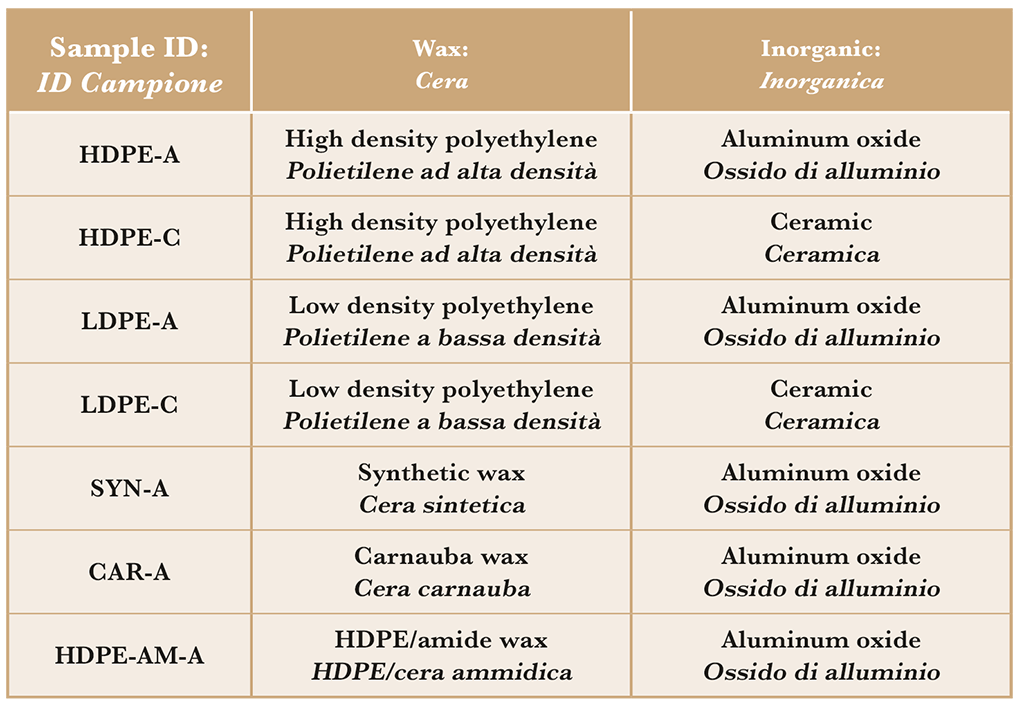
Since both aluminum oxide and ceramic particles are so dense, they will require extra energy to get them to a coating surface. As with PTFE, they will benefit from being combined with a lower density material such as HDPE in a wax composite powder. Several combinations were prepared by combining different waxes with both aluminum oxide and ceramics in an extrusion or other melt-mixing process (Tab. 3).
These composite materials were then air micronized to a fine particle size. The density of each wax composite is near or slightly higher than 1.0 to enhance efficiency and stability.

Performance – Scratch resistance
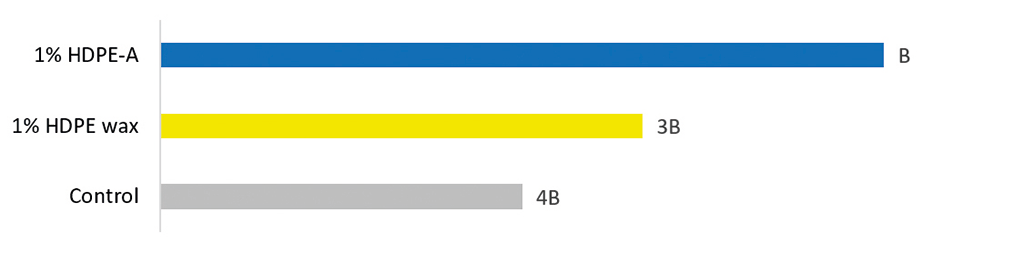
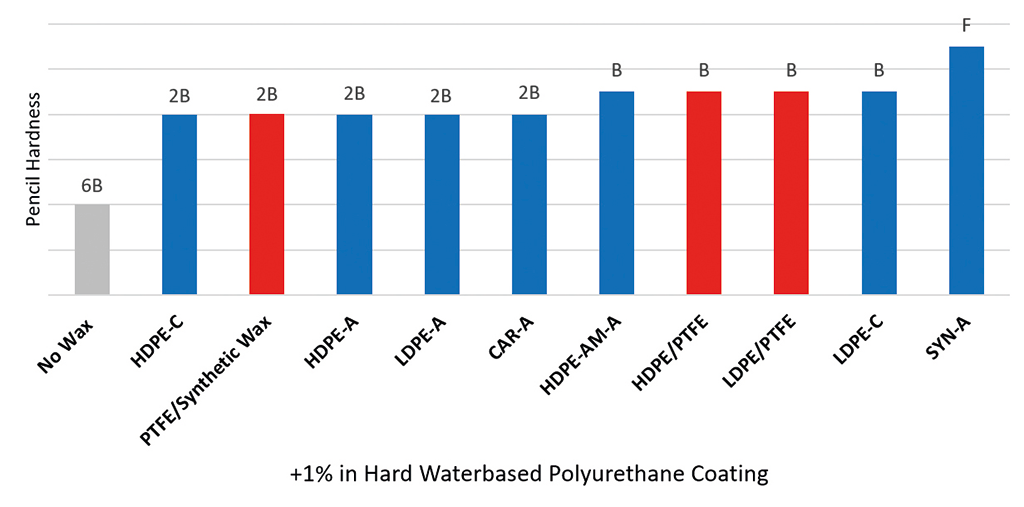
To compare the improvement in scratch resistance, each sample was first tested against the wax counterpart without the aluminum oxide modification. All samples were dosed at 1% on total formula weight in a hard water-based polyurethane dispersion coating. The dried panels were tested using a Taber linear abraser per ASTM D3363 (Fig. 1).
As can be seen in the Figure 1, the performance of the aluminum oxide modified HDPE wax (HDPE-A) is markedly superior to the unmodified HDPE wax. Similar results showing improvement were seen with all other wax combinations, where a wax modified with either aluminum oxide or ceramic demonstrated superior performance vs the same wax chemistry without inorganic modification.
A more relevant study is to compare the performance of aluminum oxide and ceramic modified composite waxes to classic PTFE based composite waxes (Fig. 2). The results demonstrate that wax composites based on both aluminum oxide and ceramic showed equal or better performance for scratch resistance vs. PTFE wax composites.

Performance – Abrasion resistance
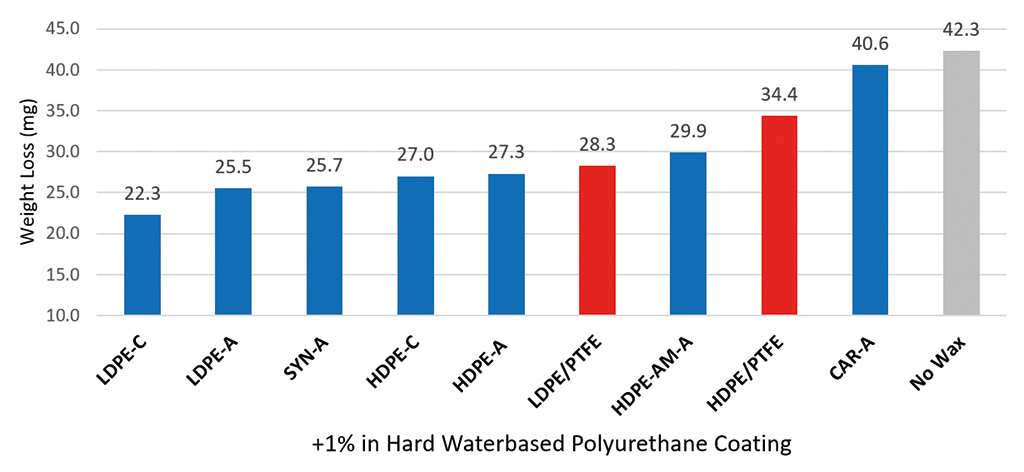
To compare the improvement in abrasion resistance, each sample was tested against PTFE composite wax powders. Each wax sample was dosed at 1% on total formula weight in a hard water-based polyurethane dispersion coating. The dried panels were tested for abrasion resistance using a Taber rotary abrader per ASTM D4060 (Fig. 3).
Conclusion
Composite wax additives based on aluminum oxide and ceramics demonstrate excellent surface durability, often outperforming classic PTFE composite wax additives. As regulations continue to threaten the use of PFAS substances,these novel additives give formulators the ability to maintain or even improve performance while removing PTFE from their formulations.
Note
1 US Patent 10,646, 212.