REACH-like Regulations: why the time to act is now

Matteo Pagani KAHLBERG CONSULTING S.R.L.

KKDIK
In recent years, the international regulatory landscape for chemicals has undergone significant acceleration, with the extension of “REACH-like” frameworks across numerous non-EU jurisdictions. For the paints and coatings sector, highly dependent on global supply chains and specialty substances, this translates into increasing operational complexity and a substantial rise in compliance burdens. The European REACH Regulation has served as a benchmark for many emerging legislations, introducing obligations for the registration, evaluation, and risk management of substances placed on the market, with the aim of ensuring a high level of protection for human health and the environment, as well as the free circulation of chemicals. Today, key markets such as Turkey, the United Kingdom, South Korea, and Ukraine are strengthening similar regulatory systems, with timelines and requirements that demand timely and structured planning. Among these, Turkey stands out due to the acceleration of the registration process under KKDIK (Kimyasalların Kaydı, Değerlendirilmesi, İzni ve Kısıtlanması Hakkında Yönetmelik), which mirrors the REACH framework but includes specific procedural and operational differences.
On March 6, 2026, the Turkish Ministry of Environment, Urbanization and Climate Change published an official announcement marking a crucial step: all companies must obtain a registration number for chemical substances by September 30, 2026, regardless of tonnage, as part of the national inventorybuilding process for substances on the Turkish market.
The announcement also clarifies that, where certain required information is not available at the time of submission, companies may formally justify data gaps and update their dossiers later through the Ministry’s IT system, up to the final registration deadlines.

After September 30, 2026, targeted inspections will be carried out on registration numbers for substances manufactured or imported, while substances introduced after that date will require completion of an inquiry and registration before market entry. For companies in the coatings sector, the message is clear: registration is not merely a formal requirement, but the starting point of a complex process involving data collection, supply chain coordination, technical assessments, and economic planning within tight timelines. In this context, structured technical and regulatory support can make a significant difference in managing timelines and priorities, guiding companies toward effective and sustainable compliance.

UA REACH
Alongside Turkey, Ukraine is also progressing in the implementation of a regulatory system aligned with the EU REACH model. Recent amendments adopted by the Ukrainian Government grant companies additional time to comply, but the timeline remains demanding and requires immediate planning.
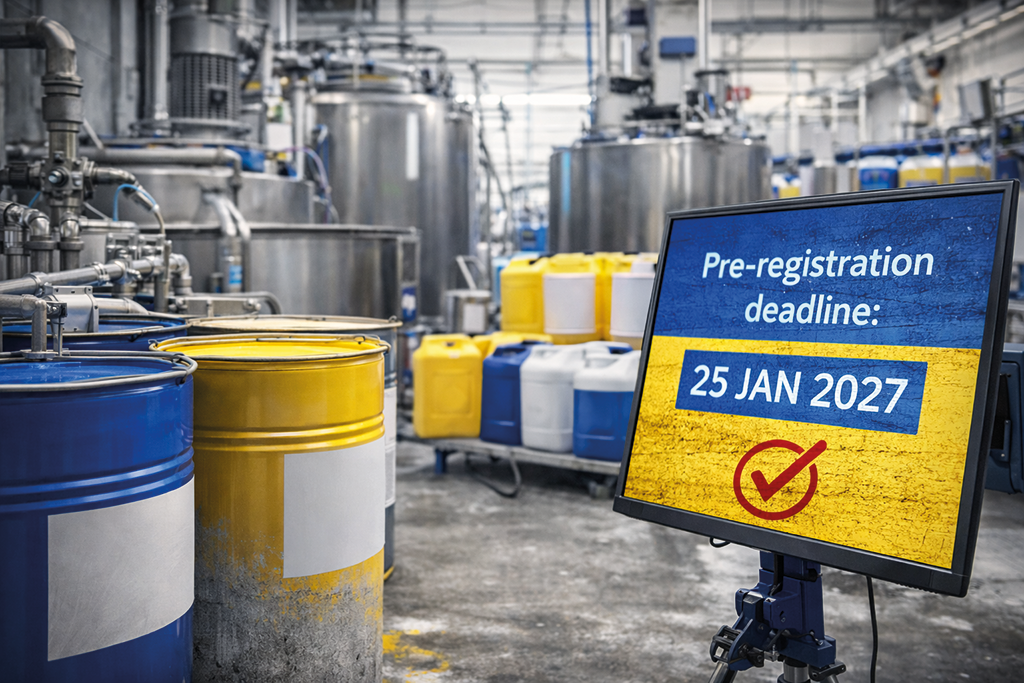
As highlighted in the Turkish case, anticipating activities ahead of official deadlines is a key success factor. According to updates from the Ministry of Economy, pre-registration is the most imminent deadline: companies must complete it by January 25, 2027. This step is essential to ensure continuity of market access and to benefit from the transitional period leading to full registration. Preregistration therefore plays a strategic role, allowing companies to maintain regulatory coverage while distributing the technical and economic burden of dossier preparation over time. Unlike other REACH-like frameworks, however, this phase requires a significantly higher level of detail: to obtain a pre- registration number, companies must submit a document in Ukrainian containing in-depth technical information on substances and manufacturing processes. Simple identification through EC or CAS numbers is not sufficient. Subsequent registration deadlines, differentiated by tonnage and hazard profile, extend over the following years in a progressive manner similar to the EU system.
This does not reduce the urgency of current activities: for many coatings companies, preparation already involves substance portfolio mapping, clarification of roles along the supply chain, and coordination with suppliers and Only Representatives. In parallel, the Ukrainian CLP system also presents elements of uncertainty.
The regulation explicitly defines only two deadlines – November 15, 2027 for substances and May 1, 2028 for mixtures—while the reference to a 12-month transitional period leaves room for interpretation regarding actual operational timelines. It should also be noted that the notification obligation formally lies with Ukrainian importers. Nevertheless, for international operators it is strategically important to support local partners upstream, ensuring business continuity and supply chain stability. Preparing notifications is more complex than it may initially appear, requiring detailed technical data and documentation in Ukrainian. For this reason, we recommend planning completion by December 5, 2026, adopting a proactive approach to minimize operational risks and ensure continued market access. In summary, for Ukraine as well, time is a critical factor: starting activities early allows companies to effectively manage technical and organizational complexity and avoid bottlenecks in later stages of the regulatory transition.


UK REACH
In the United Kingdom, upcoming registration deadlines are approaching and require early planning, particularly for EU companies operating through Only Representatives. In this context, adopting a strategic approach to compliance is essential to optimize time and resources: through integrated data management and a practical, structured approach to activity planning and supply chain coordination, it is possible to significantly reduce both timelines and costs. Thanks to our local operational presence, we support companies in defining tailored compliance strategies and guiding them through all phases of the registration process.

K-REACH
In South Korea, the registration and notification processes for new and existing substances continue to progress, with the next key deadline set for December 31, 2027 for substances ≥10 t/y. The complexity of data requirements and interactions with local authorities makes early preparation essential. In collaboration with our Korean partner, we support companies in the operational management of regulatory activities and in coordinating with the local supply chain.